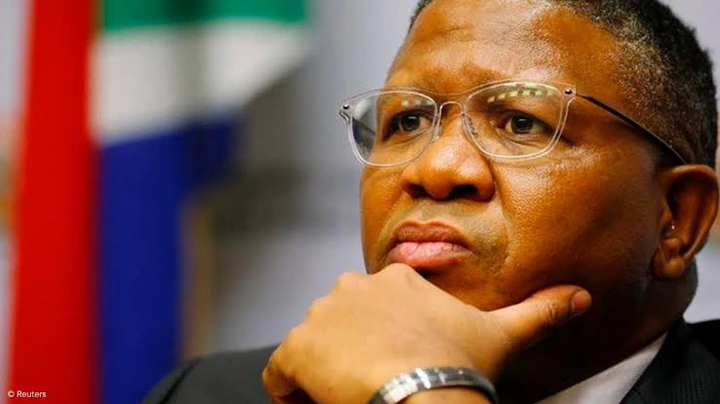
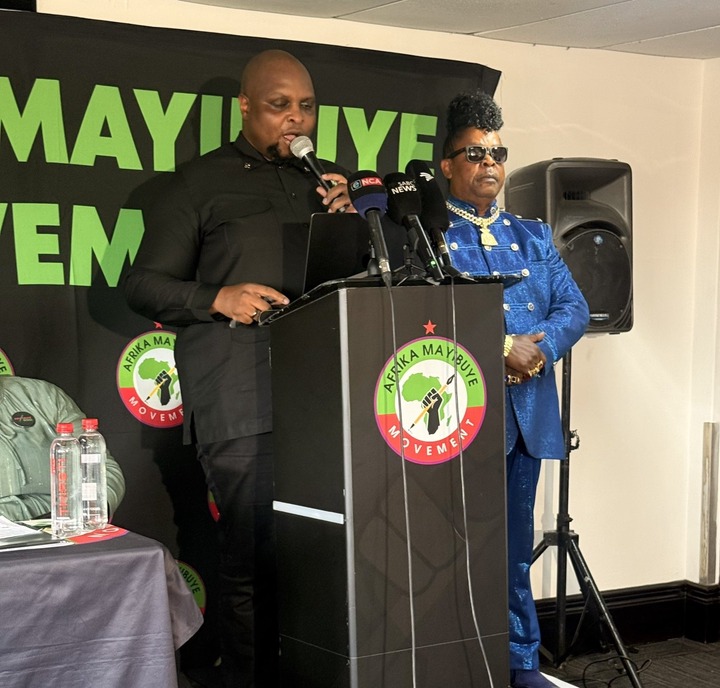
After giving a scathing critique of Orania, the self-proclaimed Afrikaner-only town in the Northern Cape, Floyd Nyiko Shivambu, the President of Mbauiye iAfrika and a former national political leader, has sparked a new debate in South Africa regarding issues of race, identity, and cultural enclaves.
During his discussion of the difficult subject of Orania’s position in South Africa after the end of apartheid, Shivambu rejected the colony as politically and socially inconsequential. He referred to it as “insignificant” and questioned the effect of its residents on the larger national discourse.
There is no significance to Orania. As Shivambu put it, “This is a group of impoverished white Afrikaners who are completely ignorant and who only understand Afrikaans.”
Coming up tonight, the new episode of my podcast, #UnpopularOpinion and we have a conversation with @FloydShivambu the leader of @mayibuye_afrika
“Orania is insignificant. It’s poor white Afrikaners who don’t know anything, who only understand Afrikaans.” ~ Floyd Shivambu… pic.twitter.com/DIbM1r9SxU
— Mzilikazi wa Afrika (@IamMzilikazi) June 20, 2026
Orania is a community that was created in 1991 with the claimed goal of maintaining Afrikaner culture, language, and self-determination. His words contribute to the ongoing national discourse that has been going on about Orania. As a result of its unique Afrikaner identity and its place in disputes about race, culture, and constitutional rights, the town has continued to be one of the most contentious settlements in South Africa.
Comments made by Shivambu are likely to elicit passionate responses from both fans and critics of the organization. Advocates of Orania have constantly contended that the town is a symbol of cultural preservation and communal self-reliance, but opponents consider it as a sign of racial separation that is in conflict with the values of a democracy that does not discriminate based on race.
In the midst of renewed political scrutiny of Orania and broader discussions about minority self-determination, land, and social cohesion in South Africa, the words made by the outspoken politician come as a surprise. Throughout the years, officials from a wide range of political ideologies have voiced opinions that are diametrically opposed to one another on the existence of the town and its future.
An increasing number of political movements are becoming increasingly dissatisfied with what they see to be ongoing racial and cultural isolation in particular communities, and political experts believe that Shivambu’s speech represents this growing anger. On the other hand, there are many who warn that such rhetoric runs the risk of further dividing people in a political environment that is already very polarised.
More than three decades after the end of apartheid, the dispute has once again placed Orania at the center of South Africa’s ongoing discussion about identity, reconciliation, and the meaning of cultural autonomy. This is because the controversy continues to develop as reactions continue to emerge.
It remains to be seen whether Shivambu’s remarks resonate with the general public or whether they cause pushback from Afrikaner organisations; but, there is no do