

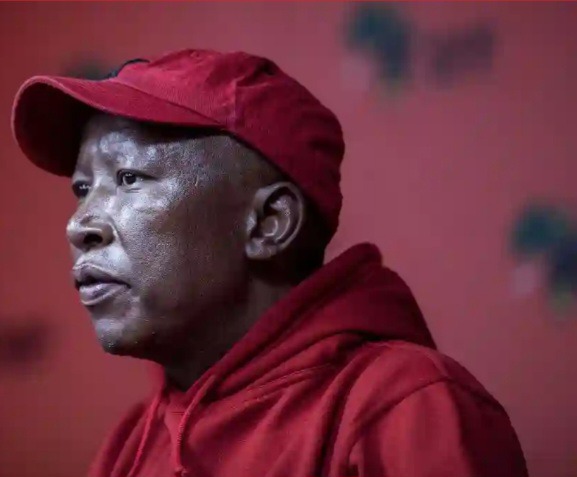
In Cape Town, a routine parliamentary session turned turbulent this week after the leader of the Economic Freedom Fighters (EFF), Julius Malema, was ordered to leave the National Assembly by Deputy Speaker Annelie Lotriet. This came after a heated exchange regarding the manner in which questions were directed at President Cyril Ramaphosa.
During the time that Parliament was holding a session for oral replies by the President, which is a procedure that is intended to hold the executive branch accountable, the incident took place. Malema posed a challenge to the way in which Deputy Speaker Lotriet was managing the proceedings. He accused her of protecting President Ramaphosa from examination and avoiding difficult questions from the opposition benches.
In spite of the numerous warnings that were given, Malema stood up to speak and declared, “You are protecting the President.” It is a cover-up, not democracy, and this is not democracy.
The newly appointed Deputy Speaker Lotriet, who was chosen as a result of a recent power-sharing deal between the African National Congress (ANC) and the Democratic Alliance (DA), issued repeated warnings before ultimately ordering Malema’s expulsion from office for violating the rules of the house. Due to the fact that the leader of the EFF refused to back down, he was removed from the chamber after being forcibly removed.
One of the Most Contentious Issues in Parliament
Legislators and members of the general public displayed an immediate reaction to the occasion. The acts of Malema have been praised by supporters of the Economic Freedom Fighters (EFF) as being bold. They have portrayed him as a voice for accountability in the face of what they view as an increasingly compromised Parliament.
The EFF Member of Parliament Naledi Chirwa stated that “He asked what others were too afraid to ask.” We are not going to be silenced for holding the President accountable for his actions.
However, members of the African National Congress (ANC), the Democratic Alliance (DA), and other opposition parties have voiced their disapproval of the disturbance, describing it as yet another instance of the EFF’s long history of engaging in political grandstanding.
A senior member of the African National Congress (ANC) parliamentarian stated, “There is a difference between robust debate and deliberate disorder.” However, what we observed was the latter.
As a result of the incident, the discussion regarding the extent to which elected representatives should challenge power has been revived, as well as the question of whether or not the aggressive tactics employed by the EFF improve or destroy democratic institutions.
A Confrontational History of the Past
Parliamentary heroism is not something that the EFF is unfamiliar with. The party has been in conflict with the presiding officers on numerous occasions ever since it was established in 2013. In order to protest policies, the party frequently causes disruptions by walking out of sessions, interrupting speakers, or wearing symbolic clothing. Some people view these strategies as a necessary disturbance, while others view them as obstructionist. Opinions have been varied on these techniques.
This most recent expulsion is just the latest in a growing series of disagreements that have occurred between the EFF and the leadership of Parliament. There have been numerous instances in which members of the EFF have been removed from their seats for violating the decorum that is anticipated in the House, particularly during sessions that involve the President or ministers.
Tensions in a System of Government That Is New
The activities of Deputy Speaker Lotriet are also being investigated in light of the fact that she plays a role in the power-sharing agreement between the ANC and the DA. It is possible that the arrangement will alienate more radical opposition voices who believe that they are being marginalised by the new establishment, despite the fact that the system was intended to facilitate cooperation in a Parliament that is highly split.
According to a political expert from Wits University, “This is what happens when the two major parties band together to silence dissent,” described the situation. “During a presidential question and answer session, the optics of a Deputy Speaker of the DA ejecting the leader of the EFF are politically loaded.”
A Challenge to the Discipline of Parliament and the Right to Free Speech
Additionally, the repercussions of the incident extend beyond the realm of party politics. It sheds light on the difficult balance that must be maintained between the enforcement of parliamentary norms and the opportunity for robust and critical discourse to develop, which is especially important in a nation that is struggling with economic uncertainty, inequality, and political upheaval.
The question that remains, despite the fact that South Africans are looking to Parliament to address urgent national challenges, is whether or not the institution is capable of maintaining order without limiting speech.
In light of the fact that elections are approaching and political tensions are at an all-time high, it is highly probable that happenings such as these will become more common and more serious.
Are you of the opinion that Malema’s decision to challenge the Deputy Speaker was appropriate? Did his removal constitute a violation of his right to free speech, or was it justified?


