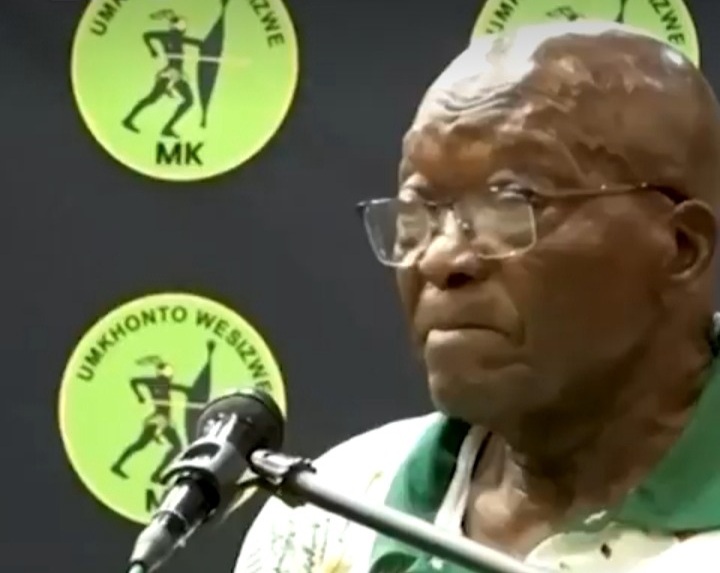
MK Party leader and former president Jacob Zuma has criticised the party’s former secretary-general, Floyd Shivambu, saying he “didn’t know what he was doing,” in remarks that have sparked discussion about leadership and internal coherence within the young political movement.
Zuma made the comments while addressing supporters at a public gathering, where he appeared to momentarily struggle to recall Shivambu’s name before dismissively referring to him as someone who lacked clarity in his role. The moment drew audible reaction from the crowd and quickly circulated on social media, where it has been interpreted as a sign of growing tension within the party’s leadership structures.
Shivambu, who previously served as deputy president of the Economic Freedom Fighters (EFF) before joining the MK Party, was appointed secretary-general as part of efforts to build organisational capacity ahead of national and provincial elections. His exit from the position, however, has raised questions about internal disagreements and the direction of the party.
Zuma did not provide specific details about what he believed Shivambu had done wrong, but his blunt assessment suggested dissatisfaction with how the former SG handled party affairs. The comments come amid ongoing efforts by the MK Party to consolidate its structures and define its ideological identity following its rapid rise in national politics.
Political analysts say Zuma’s remarks may reflect deeper challenges within the party as it transitions from a campaign-focused movement into a structured political organisation. Building internal discipline, establishing clear lines of authority, and managing high-profile personalities are common difficulties for new parties, particularly those formed around a dominant political figure.
The MK Party has attracted significant attention since its formation, drawing support from disillusioned voters and former members of other political organisations. However, its leadership dynamics have frequently come under scrutiny, with critics arguing that public disagreements could undermine its credibility.
Shivambu has not publicly responded to Zuma’s comments. In the past, he has defended his role within the MK Party, saying his intention was to contribute to organisational growth and strengthen the party’s national footprint.
Opposition parties and political commentators have seized on the incident as evidence of instability, while MK Party supporters have largely downplayed the remarks, describing them as part of a broader process of internal correction and consolidation.
As the MK Party prepares for future electoral contests, questions remain about how it will manage leadership transitions and internal disputes. Zuma’s comments, while brief, have highlighted the challenges facing the party as it seeks to transform popular support into a durable political structure capable of long-term governance.