

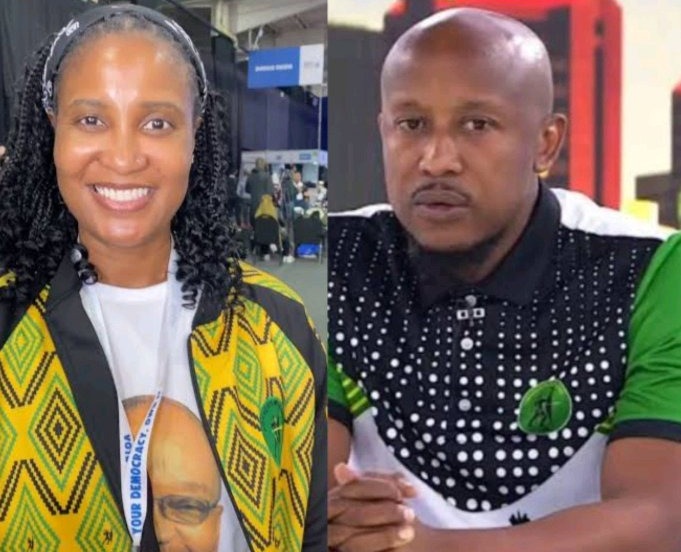
Floyd Shivambu pointed his finger at two names who are widely known in South Africa, and on Thursday, the carefully managed public image of the MK Party opened up in a way that was completely unrecognisable. The former EFF commander who is now the Secretary-General of the MKP identified Duduzile Zuma-Sambudla and Nhlamulo Ndhlela as members of a protected inner circle. He accused them of using drugs and launching late-night social media assaults on other party structures. He spoke with an unusually direct tone. Figuratively speaking, the room became quite quiet shortly after.
In a public statement, Shivambu acknowledged the statements and informed supporters that some people inside the uMkhonto we Sizwe Party operate with what is seen to be immunity from punishment. “We spoke against the untouchables in the MKP, people who take drugs and tweet at night to insult us — the likes of Duduzile Zuma and Nhlamulo Ndhlela,” he said. While Zuma-Sambudla is President Jacob Zuma’s daughter and a loud online supporter for her father’s political movement, Ndhlela operates as a visible partisan communicator with a big digital following. Both of these persons are notable in their respective fields.
“We spoke against the untouchables in the MKP, people who take drugs and tweet at night to insult us. The likes of Duduzile Zuma and Nhlamulo Ndhlela.” – @FloydShivambu 🔥🔥🔥 pic.twitter.com/QmRdYEXIFE
— Kganki Chávez Mphahlele 🇿🇦 (@Absolute_Kganki) June 19, 2026
By the time the publishing deadline arrived, neither Duduzile Zuma-Sambudla nor Nhlamulo Ndhlela had sent their official reply. Similar to the last example, the national headquarters of the MK Party did not provide any remark about Shivambu’s description of the failings in internal discipline. Requests that were addressed to representatives for the MKP were not replied, which means that his inflammatory portrayal is still in effect without any reaction from headquarters.
Under the cover of cleverly written news releases, tensions between Shivambu’s group and loyalists affiliated with the Zuma family have been building up for some months. The former deputy head of the Economic Freedom Fighters crossed the floor, bringing with him not just strategic might but also independent ambition, and observers of South African opposition politics immediately saw a rising conflict between the two parties. The MKP, which was formed on enormous electoral momentum in 2024, is now confronted with the same factional gravity that any liberation-aligned organization inevitably experiences. Power seldom splits smoothly.
One of Shivambu’s supporters who was photographing the gathering recorded the moment when his jaw tightened just before he read out the names. He was casual in his posture and everything but measured in his content. He wore a black jacket and did not wear a tie. Behind him, three younger party volunteers exchanged looks with wide eyes, clearly taking in the seriousness of what their senior official had just communicated to all of the journalists who were watching.
Despite the fact that their names are now associated with this particular claim, the situation of Duduzile Zuma-Sambudla and Nhlamulo Ndhlela has not been settled anywhere. Will Jacob Zuma’s family remain mute and take the hit, or will they respond with a strike? Those South Africans who have founded their hopes on the unity of the MKP want to know if responsibility inside that party belongs to everyone or exclusively to those who do not have a name that is particularly influential.


