

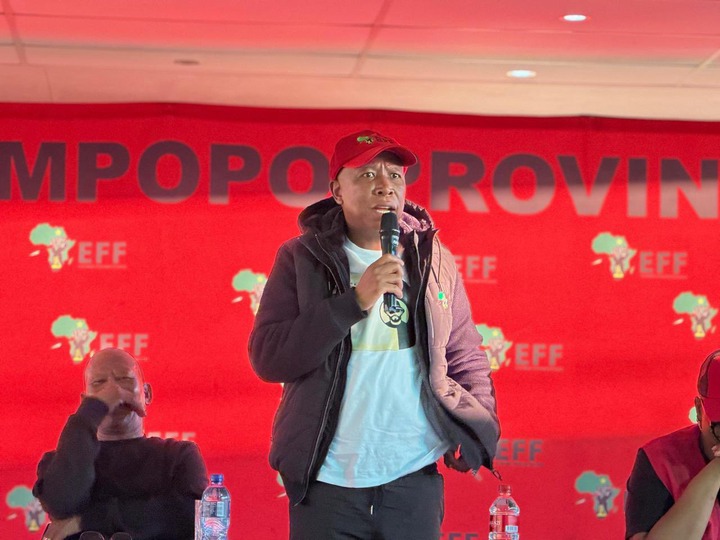
South Africa’s political theater reached a fever pitch as Economic Freedom Fighters (EFF) leader Julius Malema launched yet another blistering attack on President Cyril Ramaphosa, this time framing the president as both a historical collaborator and a constitutional failure. Speaking with characteristic rhetorical fire, Malema accused Ramaphosa of betraying the liberation struggle’s legacy, labelling him a “collaborator” who prioritised personal gain over the emancipatory promises of 1994 . The verbal assault, which invoked Nelson Mandela’s memory and questioned Ramaphosa’s anti-apartheid bona fides, represents the latest chapter in a bitter personal and political rivalry that has come to define South Africa’s opposition politics .
At the heart of Malema’s critique is the Phala Phala farm robbery scandal, which he has weaponised as evidence of presidential unfitness. Malema declared that Ramaphosa has “brought shame into the Union Buildings” and vowed that the EFF-led impeachment committee in Parliament will succeed in removing him . This follows Ramaphosa’s failed court attempt to interdict the committee’s work—a move Malema characterised as a desperate evasion of accountability. The EFF leader has consistently argued that the scandal, involving millions in undeclared foreign currency allegedly stolen from Ramaphosa’s farm, exposes a pattern of corruption and abuse of state resources that the president cannot escape .
Beyond the scandal, Malema has attacked Ramaphosa’s policy record, dismissing the National Development Plan’s Vision 2030 as “meaningless” and pointing to worsening poverty and unemployment under his watch . The EFF leader also rejected the Land Expropriation Act signed by Ramaphosa, describing it as a “legislative scam” that fails to deliver meaningful land justice . “We don’t want hijacked buildings, they are rotten,” Malema scoffed, demanding instead the expropriation of productive farms and mines. This policy critique is layered with personal scorn, as Malema has repeatedly questioned Ramaphosa’s commitment to radical economic transformation, portraying him as a project of “white capitalists” .
The attacks have also taken on a constitutional dimension, with Malema accusing Ramaphosa of undermining the rule of law. When Ramaphosa met with former US President Donald Trump, Malema blasted him for failing to defend the Constitutional Court’s ruling that the “Kill the Boer” chant is not hate speech . “He threw the Constitutional Court under the bus,” Malema charged, arguing that Ramaphosa’s silence effectively capitulated to foreign pressure and disrespected South Africa’s highest judicial authority. This accusation resonates with Malema’s broader narrative that Ramaphosa is a weak leader beholden to external interests rather than the country’s constitutional order .
Yet Malema’s offensive comes amid his own legal and ethical controversies. Recent allegations linking him to suspended Crime Intelligence deputy head Major-General Feroz Khan raise uncomfortable questions about whether parliamentary oversight has been co-opted for private political games . WhatsApp messages allegedly show Khan drafting parliamentary questions for Malema—a revelation that threatens to undermine the EFF leader’s moral authority. As the Phala Phala inquiry proceeds and the Constitutional Court compels Parliament to reconsider impeachment proceedings, the battle lines are drawn . Whether Malema’s attacks will succeed in unseating Ramaphosa or merely expose both men’s vulnerabilities remains to be seen, but one thing is certain: South Africa’s political drama has entered its most volatile chapter yet.


