

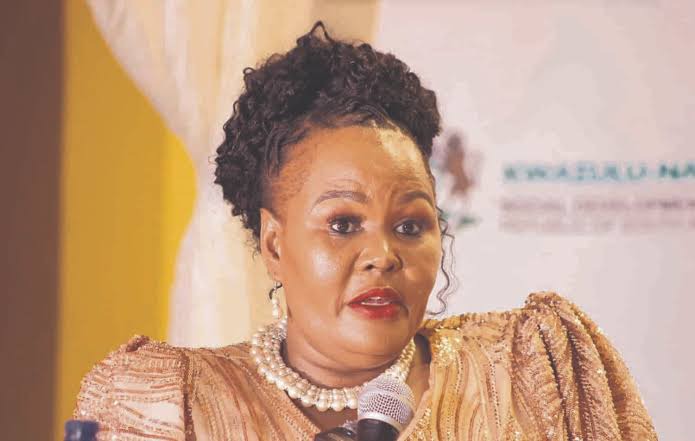
KwaZulu-Natal’s political landscape has been thrown into renewed tension after the MK Party in the provincial legislature formally wrote to Premier Thamsanqa Ntuli demanding urgent clarity over a vacant cabinet position that has remained unfilled following the recall of former MEC Mbali Shinga by the NFP.
The move has opened up fresh questions about governance stability in the province, with growing concern over how long key executive functions can remain in limbo without a permanent replacement.
At the centre of the dispute is the abrupt recall of Mbali Shinga by the NFP, a decision that effectively removed her from her role in the provincial executive. While the recall itself has been acknowledged within political circles, what has since triggered wider controversy is the silence and delay surrounding what comes next for the vacant portfolio.
In a formal communication submitted to Premier Ntuli, the MK Party is pressing for a clear explanation of the government’s plan. The party wants to know whether a replacement has been identified, whether negotiations are still ongoing among coalition partners, or whether internal restructuring is being considered before any appointment is made.
The MK Party argues that the continued delay is not a minor administrative issue but a governance concern that could have direct consequences on service delivery. According to party representatives, every day the position remains vacant increases uncertainty within the department it oversees, potentially slowing down decision-making processes and weakening oversight structures.
Premier Thamsanqa Ntuli, who now finds himself at the centre of mounting political pressure, is expected to respond to the legislature’s concerns in the coming days. His office has not yet issued a detailed public explanation, but political observers say the situation places him in a delicate position, balancing coalition dynamics while maintaining administrative stability.
Inside the KwaZulu-Natal Legislature, the matter has quickly become a talking point among multiple parties. Some lawmakers argue that the delay reflects deeper coordination challenges within the provincial executive, particularly in a political environment shaped by shifting alliances and coalition negotiations.
Others view the MK Party’s intervention as a calculated move to assert oversight influence and push for greater transparency in executive appointments. By formally demanding clarity, the party is effectively placing pressure on the Premier to disclose internal processes that are often handled behind closed doors.
The situation has also raised broader questions about how quickly provincial governments can respond when senior officials are recalled or removed. In cases where portfolios are left vacant, even temporarily, departments are often forced to operate under acting leadership, which some critics argue can slow down long-term planning and policy execution.
Political analysts note that KwaZulu-Natal’s coalition environment has made such transitions more complex. With multiple parties involved in governance arrangements, agreement on replacements can take time, particularly when negotiations involve balancing political representation, experience, and strategic interests.
The recall of Mbali Shinga has therefore become more than an isolated personnel change. It has evolved into a test of how efficiently the provincial executive can manage internal disruptions while maintaining public confidence in its operations.
For now, attention remains firmly on Premier Ntuli. His response will likely determine whether the matter settles quietly through internal negotiations or escalates further into a public political standoff within the legislature.
What is clear is that the MK Party’s intervention has shifted the issue from a procedural vacancy into a broader debate about governance accountability, coalition coordination, and the pace at which leadership decisions are made in KwaZulu-Natal’s provincial government.


