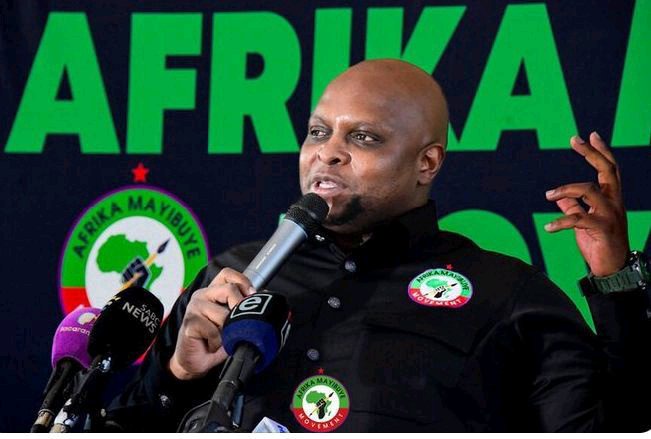
Former EFF deputy president and President of the Afrika Mayibuye Movement, Floyd Shivambu, has warned political leaders not to laugh off grassroots protests or people’s anger, saying that doing so could end up driving ordinary citizens straight into the hands of dangerous reactionary forces.
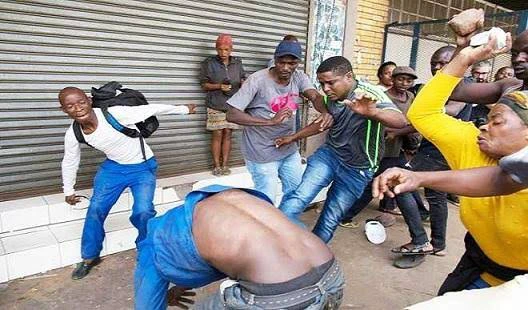
Speaking in the middle of the heated debate around the March and March movement, Shivambu defended public protests no matter how small the crowd may be. He said people’s complaints should be treated seriously instead of being mocked by politicians trying to score points.
“It’s counter-revolutionary to delegitimise the cries of the people, whatever number they are,” Shivambu said. “Let’s not insult the March and March processes led by Jacinta Ngobese, Ngizwe Mchunu and Phakela Mthakath because we’re going to push them away to reactionary right-wing forces funded by the captains of South Africa’s economic industry.”
His comments come as the country continues to argue about the role of civic movements and protest action in public life. The March and March initiative, led by activist Jacinta Ngobese-Zuma together with Ngizwe Mchunu and Phakela Mthakath, has been presenting itself as a platform for ordinary people who want more say in how the country is run.
Shivambu said leaders who see themselves as progressive should be engaging with angry communities instead of dismissing them because they dislike the organisers or do not agree with the politics. In his view, real democracy means listening when people speak out about unemployment, poverty, failing services, and the growing cost of living.
He also warned that when leaders ignore or belittle these voices, they create space for other groups with agendas that may not help ordinary South Africans at all. In other words, if mainstream politics shuts people out, someone else will gladly step in and use that frustration.
The debate is happening against a backdrop of deep public frustration over joblessness, poverty, service delivery failures, and inequality. Many South Africans already feel ignored, and that is exactly why protest movements continue to find an audience, even when political parties try to downplay them.
Shivambu’s remarks also shine a light on the growing tension between established political structures and newer civic movements. As more citizens look for different ways to be heard, the big question is how politicians should respond without making the divide even worse.
Supporters of the March and March movement will likely see Shivambu’s words as a strong defence of the right to protest and organise. Critics may say that talk is cheap unless it is backed by real solutions and practical action.
Still, Shivambu insisted that the starting point for any democratic society should be respect for the people’s voice. His warning was clear: if leaders keep brushing off public anger, the political consequences could be serious.



![[Scoop]: Trouble For Mbalula As Cyril’s Allies Asked Him To Step Aside](https://ireportsouthafrica.co.za/wp-content/uploads/2023/06/7aae052461a243d38cf89de679f920a1.webp)