

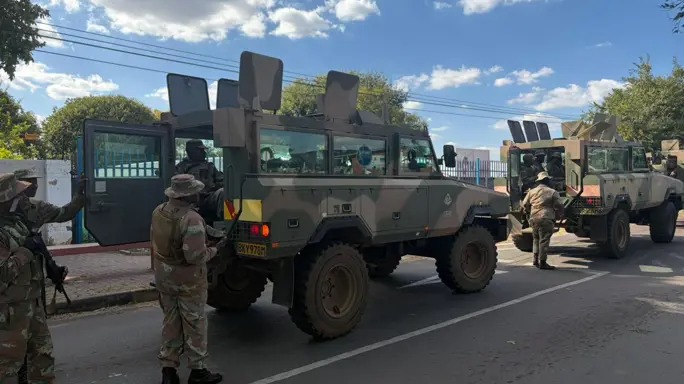
Residents in parts of southern Johannesburg woke up on Wednesday, 11 March 2026, to the sight of armoured vehicles moving through their streets as dozens of South African National Defence Force (SANDF) soldiers joined the police in a major anti-crime operation.
The raids, which took place in areas including Eldorado Park, Riverlea, and Westbury, targeted properties suspected of housing contraband and illegal firearms. According to South Africa’s Constitution, the president is allowed to deploy the defence force internally to assist the police in preserving life, health, or property and to maintain law and order.
The law also requires that Parliament be promptly informed about the reasons for the deployment, the locations where troops are sent, and the expected duration of their mission.
The joint operation forms part of the government’s broader strategy to combat increasing crime levels in parts of Gauteng that have struggled with drug-related activity and gang violence.
While the operation has been welcomed by some residents who say they hope it will bring relief to their communities, questions have been raised about the legal framework governing the deployment.
Concerns were voiced by the Democratic Alliance’s (DA) Parliamentary Portfolio Committee on Police chairperson, Ian Cameron, who said Parliament had not received notification of a new SANDF mission.
“I have written urgently to the National Commissioner to ask him for clarity on the legal basis of the deployment, the command structure, the rules of engagement. South Africans desperately need safer communities, but this must happen within clear and legal frameworks,” Cameron said.
Legally, the president(Cyril Ramaphosa in this case) does have discretion to authorize military assistance in cooperation with police efforts, but the constitutional requirement of parliamentary oversight remains an essential part of ensuring accountability.
The speed of the current deployment and the apparent lack of formal notification have sparked debate about whether procedural steps were properly followed.
From a broader perspective, the use of the military in domestic policing continues to reflect the tension between security and constitutional rights in South Africa. Deploying soldiers on home soil can be a powerful signal of the government’s intent to restore order, but it also risks normalizing a militarized approach to civilian crime.
While communities may momentarily feel safer, long-term security cannot rely solely on force—it must also address systemic social and economic factors that give rise to criminal activity in the first place.
The current operations highlight the government’s struggle to maintain stability while adhering to constitutional principles.
Whether this collaboration between the SANDF and police becomes an effective, lawfully grounded response to crime will depend on the transparency of its implementation and the accountability that follows once the armoured vehicles leave the streets.


