

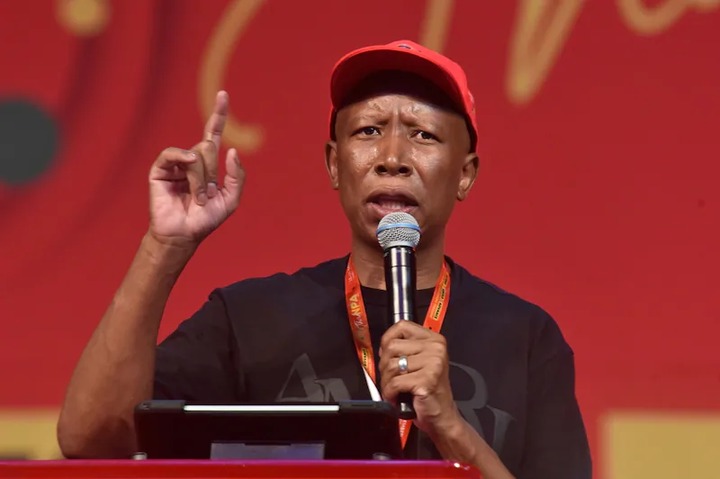
Julius Malema, the leader of the Economic Freedom Fighters (EFF), has issued a warning to President Cyril Ramaphosa, urging him to advise ministers within the Government of National Unity (GNU) from adopting anti-foreigner rhetoric for political benefit. He further warned that xenophobia cannot be a path to national leadership.
During a recent public address, Malema gave a speech in which he urged Ramaphosa to take a tough stand against cabinet members who, in his opinion, are promoting hostility toward foreign nationals in an effort to get support from voters. In his remarks, the leader of the EFF emphasised that such behaviour poses a threat to social cohesion and weakens democratic ideals in the country.
According to Malema, the president ought to remind members of the GNU that inciting or tolerating violence against foreigners is not acceptable and has the potential to further destabilise communities all around South Africa. “Xenophobia will not make you a president,” Malema said, adding that political leaders have a responsibility to defend all individuals living in the country regardless of their nationality. “Xenophobia will not cause you to become president.”
Julius Malema tells President Cyril Ramaphosa to remind some ministers in his GNU cabinet that “xenophobia will not make you a president” and to denounce anyone harming foreigners to gain votes.#SONADebate pic.twitter.com/0bC5xFnsPQ
— MDN NEWS (@MDNnewss) February 17, 2026
The Economic Freedom Fighters (EFF), which is led by Malema, has continuously taken a stance against xenophobic violence. They have argued that economic difficulties and unemployment should not be attributed to those who are not citizens of the country. It was underlined by Malema that foreign nationals frequently make contributions to the economy through the creation of jobs, the supply of needed services, and participation in entrepreneurial endeavours.
His comments come at a time when political tensions are building and public debate is taking place about immigration policies, economic issues, and rising unemployment rates. Recent criticism has been levelled against a number of prominent personalities within the GNU for utterances that are interpreted as being directed at foreign nationals. This has sparked concerns about the possibility of renewed xenophobic violence.
Furthermore, Malema encouraged Ramaphosa to openly condemn any political leader or government official who seeks to gain popularity by fostering anti-immigrant sentiment. Ramaphosa was made aware of this by Malema. He issued a warning that such speech could result in violent acts and cause harm to the prestige of the nation on the international stage.
The comments made by Malema, according to political observers, are reflective of broader worries regarding the possibility of using migration as a political campaign topic in advance of future elections. They point out that even while immigration is still a touchy subject among voters, the use of rhetoric that is provocative runs the risk of further dividing populations that are already susceptible and exacerbating tensions in those communities.
An official reaction from the presidency has not yet been published in response to the remarks made by Malema. On the other hand, Ramaphosa has before expressed his disapproval of acts of violence motivated by xenophobia and reaffirmed South Africa’s unwavering dedication to safeguarding the rights and dignity of every individual who resides inside its borders.
In conclusion, Malema cautioned that divided politics might have long-term repercussions for the unity and stability of the nation, and he urged political leaders to concentrate on finding long-term answers to the nation’s economic problems rather than blaming its problems on foreign nationals.


