

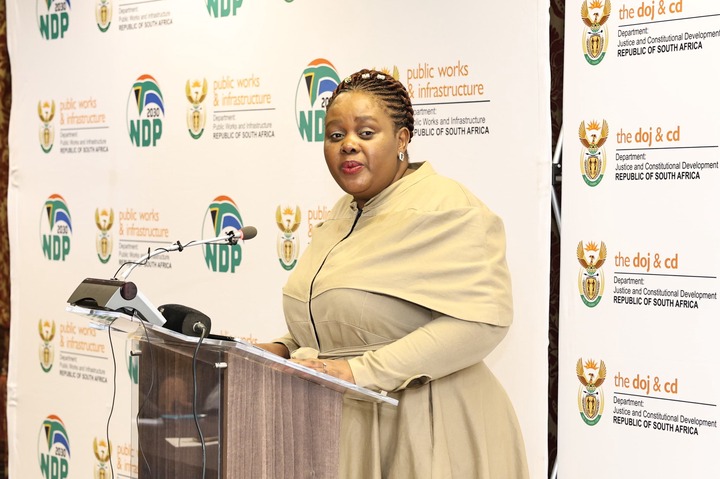
In a stunning revelation that adds a complex new layer to the assassination of a key judicial witness, Justice Minister Mmamoloko Nkhensani Kubayi has confirmed that the murdered man, whose identity was revealed as Marius van de Merwe, had formally declined state protection.
The disclosure came during a somber media briefing, shifting the narrative around the killing that has gripped the nation and threatened the Madlanga Commission of Inquiry.
Minister Kubayi detailed that Van de Merwe, the individual known only as Witness D, turned down the state’s security offer based on his professional background, believing his own expertise and resources were superior.
The Minister’s statement provided the first official motive for the witness’s lack of police protection, a decision that has now proven fatal.
“Justice Minister @mmkubayi has confirmed during a media briefing that Witness D, whose identity has now been revealed as Marius van de Merwe, was offered protection but declined because he owned his own security company,” the official account of veteran journalist, Ziyanda Ngcobo stated.
This crucial detail paints a picture of a man who was confident in his own ability to manage risk, a confidence rooted in his ownership and presumed expertise in the private security sector.
The revelation that Van de Merwe was a security company owner introduces a tragic irony to his murder, highlighting a potentially fatal miscalculation of the threat he faced.
This new information immediately triggers a series of urgent questions for the ongoing investigation led by the South African Police Service (SAPS).
Authorities are now forced to scrutinize Van de Merwe’s own security arrangements, his company’s personnel, and its protocols. The possibility of an inside leak or a targeted breach of his private security detail becomes a paramount line of inquiry.
Did his high-profile role as a witness make him a target that no private security firm, including his own, could adequately shield from a determined, state-level threat? The use of a military-grade AK-47 in the assassination suggests the hitmen were equipped to overwhelm almost any conventional private security response.
The minister’s disclosure also places a renewed and intense spotlight on the protocols for protecting witnesses in high-stakes judicial proceedings.
While the state fulfilled its duty by offering protection, the case of Marius van de Merwe exposes a critical vulnerability: the inability to compel a witness to accept safety measures when they believe themselves to be secure.
This gap in the system has now had the most dire consequence imaginable. In the wake of this tragedy, the Justice Department, in conjunction with SAPS, will be under immense pressure to review and potentially strengthen these protocols.
The discussion will inevitably turn to whether, for witnesses of a certain calibre in commissions investigating powerful and dangerous networks, the option to decline protection should even exist.
The death of Marius van de Merwe is no longer just a murder mystery; it is a stark lesson in the limits of private enterprise against orchestrated political violence and a catalyst for a fundamental rethink of how the state safeguards those who agree to testify in its most sensitive matters.


