

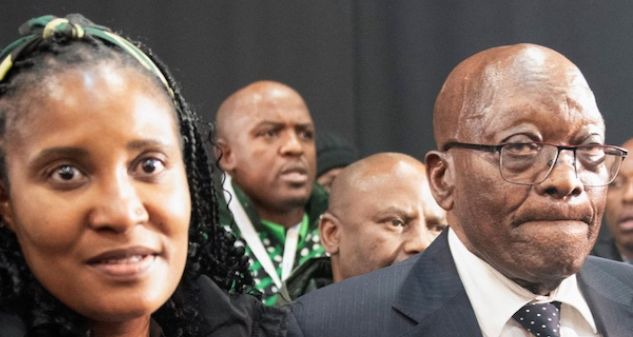
Speculation has grown within South Africa’s political landscape over reports suggesting that former President Jacob Zuma may have politically distanced himself from his daughter, Duduzile Zuma-Sambudla, amid rising concerns over public conduct, party discipline, and reputational management within the uMkhonto weSizwe (MK) Party.
Although there has been no official confirmation from Jacob Zuma or the MK Party describing any form of “disownment,” recent developments have fuelled debate among political analysts about a possible strategic separation between family identity and party messaging.
Duduzile Zuma-Sambudla, a prominent and outspoken figure within the MK Party, has repeatedly attracted controversy due to her strong political statements, particularly on social media platforms. Her comments have often sparked public criticism, drawn backlash from opposition parties, and at times placed the MK Party under heightened scrutiny.
According to political observers, the perceived distancing may be linked to efforts by the MK Party leadership to tighten internal discipline and maintain a consistent public image as it continues to position itself as a major political contender in South Africa’s evolving electoral landscape. Analysts argue that in highly competitive political environments, parties often seek to limit reputational risks associated with high-profile members whose public statements may be viewed as inflammatory or divisive.
In this context, Jacob Zuma’s alleged political distancing is being interpreted not necessarily as a personal or familial break, but as a calculated move aimed at protecting the broader political structure and avoiding distractions that could weaken the party’s electoral appeal.
Some commentators further suggest that the MK Party’s leadership may be under pressure to demonstrate organisational maturity, particularly as it seeks to expand its support base. Ensuring message control and internal cohesion has therefore become a priority, especially for figures closely associated with the party’s founding leadership.
However, supporters of Duduzile Zuma-Sambudla have dismissed the narrative of a political fallout, arguing that she remains firmly aligned with the MK Party’s ideological stance and continues to be an active voice within its ranks. They contend that reports of a “disownment” are exaggerated and politically motivated attempts to create divisions within the Zuma political network.
Political analysts also caution that South African politics is often characterised by intense speculation, where family relationships of prominent leaders are frequently interpreted through a political lens, sometimes without substantiated evidence.
As of now, there has been no formal statement confirming any rupture between Jacob Zuma and his daughter, either personally or politically. Until such clarification is provided, claims of a political disownment remain unverified.
What remains evident, however, is that the Zuma political brand continues to attract significant public attention, where internal family dynamics are often scrutinised as part of broader political narratives shaping the country’s opposition landscape.


