

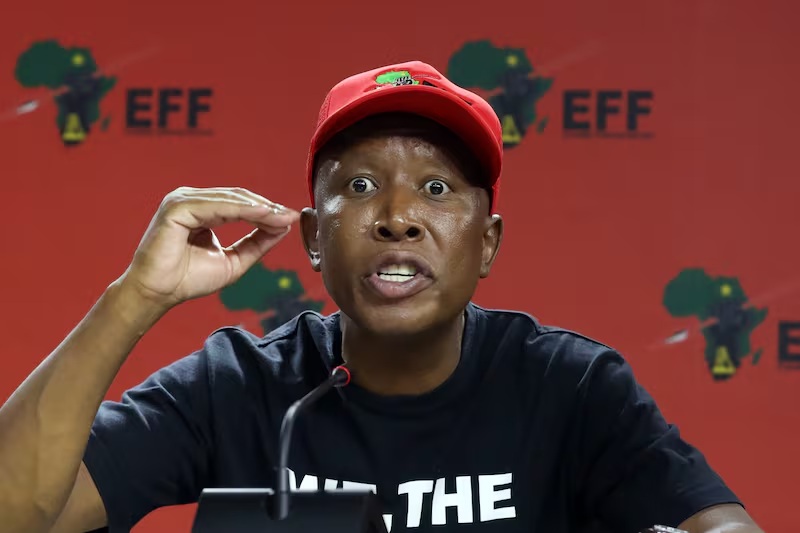
Economic Freedom Fighters (EFF) leader Julius Malema is facing renewed public scrutiny over his residence in one of Johannesburg’s most affluent suburbs, reigniting debate around wealth, political ideology and public perception in South Africa.
Malema, a prominent and often outspoken critic of economic inequality, lives in Hyde Park, an upscale suburb known for its luxury homes, private security and exclusive estates. The revelation has once again drawn attention to the contrast between his party’s calls for radical economic transformation and his personal lifestyle.
Critics argue that the EFF’s strong stance on wealth redistribution and opposition to elite privilege appears inconsistent with its leader residing in one of the country’s most prestigious neighbourhoods. They contend that such optics may weaken the party’s messaging in a society marked by deep economic disparities.
Supporters of Malema, however, maintain that political leaders are entitled to personal success and financial stability, provided their wealth is lawfully acquired and properly declared. They argue that focusing on his residence shifts attention away from pressing national issues such as unemployment, poverty and structural inequality. Malema has previously stated that his assets are legitimate and disclosed in accordance with legal requirements.
Political analysts suggest the controversy reflects a broader dynamic in South African politics, where symbolism and lifestyle often influence public perception as much as policy positions. In a country grappling with one of the highest inequality rates globally, the personal circumstances of political figures frequently become part of the national conversation.
As debate continues, the issue underscores the heightened scrutiny faced by high-profile leaders and the complex relationship between political messaging, personal wealth and public expectations.


