

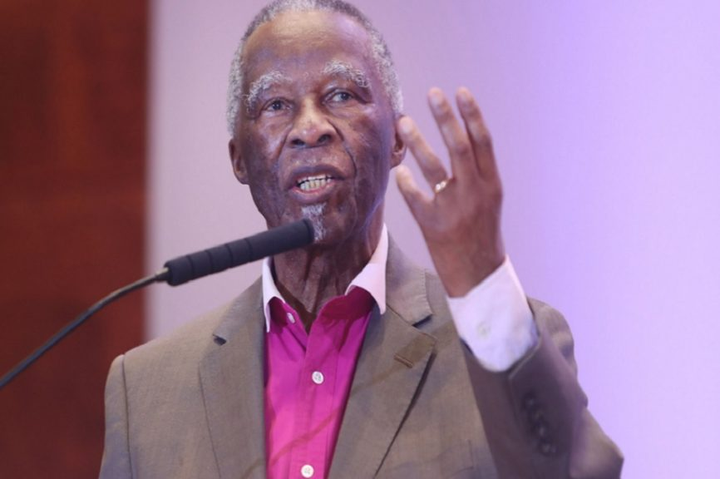
Former South African president Thabo Mbeki has attributed the country economic decline to changes in political leadership and policy direction following his departure from office. Speaking during a recent public engagement the former head of state suggested that leadership transitions within the governing party played a significant role in altering the trajectory of the nation’s economy.
Mbeki, who served as president of South Africa from 1999 until 2008, reflected on the period following his administration and argued that the shift in leadership introduced new governance approaches that impacted economic stability and long-term planning. According to him, the change not only affected policy continuity but also weakened the strategic vision that had guided the country’s economic development during his tenure.
The former president explained that strong and consistent leadership is critical for maintaining investor confidence, sustaining growth, and ensuring effective economic management. He suggested that disruptions in leadership within the ruling party created uncertainty, which may have contributed to declining economic performance and slower growth rates in subsequent years.
During his presidency Mbeki oversaw a period of relatively stable economic expansion, with efforts focused on strengthening fiscal discipline increasing trade opportunities, and promoting regional cooperation across the African continent. His administration also emphasized initiatives aimed at improving infrastructure and expanding South Africa’s global economic partnerships.
However, Mbeki noted that leadership changes often bring shifts in priorities and strategies. He said these adjustments can sometimes undermine ongoing programs if they are not managed carefully. According to him the challenge for any government is to ensure continuity in critical policies while still adapting to evolving national and global economic conditions.
South Africa’s economy has faced multiple pressures in recent years, including high unemployment, sluggish growth, and persistent inequality. Analysts often cite a range of contributing factors, including global market fluctuations, domestic policy debates, and governance challenges.
While Mbeki did not single out specific individuals, his remarks have sparked discussion within political and economic circles about the long-term impact of leadership transitions on the country development path. Some commentators argue that leadership stability is essential for economic consistency while others believe broader structural issues are responsible for the current challenges.
Despite differing views Mbeki emphasized the importance of strategic leadership in navigating complex economic realities. He encouraged current leaders to focus on long-term planning policy consistency and inclusive development to help restore economic confidence.
As debates about South Africa economic future continue Mbeki commen


