

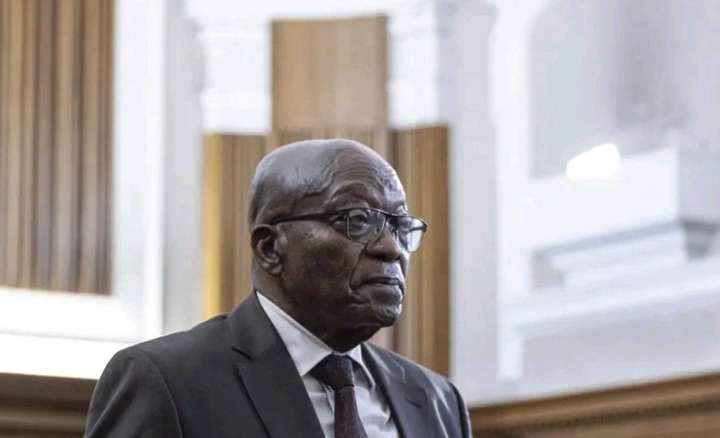
Former President has restated his desire to challenge his expulsion from the African National Congress (ANC), while simultaneously expressing hope that the ANC and the MK Party may one day combine into a single party.
In spite of the fact that he was kicked out of the African National Congress (ANC) for publicly supporting and campaigning for the MK Party, Zuma claims that his removal was both politically motivated and defective in terms of procedure. In his statements made at recent get-togethers with supporters, he stated that he continues to be a devoted member of the liberation struggle and that he plans to seek any and all available channels in order to regain his membership.
Zuma reminded his followers, “I have dedicated my life to the African National Congress.” He emphasised that his decades-long commitment in the fight against apartheid and subsequent governance cannot be erased by what he considers to be mistakes made by internal factions. As opposed to being a transient political structure that is attached to particular leaders, he contended that the African National Congress (ANC) reflects a historical mission.
Zuma stated that ideological differences between the two organisations are not insurmountable, despite the fact that he is the leader of the MK Party, which is named after the ANC’s former military wing from the past. Additionally, he expressed optimism that the larger liberation movement may be strengthened through the process of reconciliation and eventual cooperation. According to Zuma, it is vital for political forms that share similar beliefs to work together in order to confront the difficulties of economic inequality, unemployment, and governance that South Africa is currently facing.
The leadership of the African National Congress (ANC) has defended its decision to exclude Zuma by noting that the party’s statutes expressly prohibit members from founding or supporting political organisations that are in competition with the ANC. When the party is under electoral challenges and internal divisions, officials have emphasised how important it is to maintain organisational integrity and discipline. This is especially true at this moment.
As far as political observers are concerned, Zuma’s statements regarding the possibility of a merger are a combination of strategic calculation and symbolic message. Significant support for the MK Party has been garnered in important provinces, which has resulted in a reworking of political dynamics and a reduction in the traditional voter base of the ANC. It is possible that Zuma is attempting to position himself as a bridge between different factions within the larger liberation struggle by arguing for unity rather than permanent separation.
There is still a lack of clarity around the possibility of a merger. In a public statement, senior officials within the African National Congress (ANC) have refuted such conjecture, highlighting the fact that the party continues to be dedicated to its constitutional procedures and established leadership structures.
Meanwhile, Zuma is continuing his legal and political struggle to restore his membership in the African National Congress (ANC). His attitude highlights the underlying contradictions that exist within South Africa’s dominant political tradition. Regardless matter whether the disagreement results in a reconciliation, a lengthy confrontation, or a restructuring of alliances, it is abundantly evident that Zuma intends to continue to play a pivotal role in the ongoing discussion regarding the development of the liberation movement’s future course of action.


