

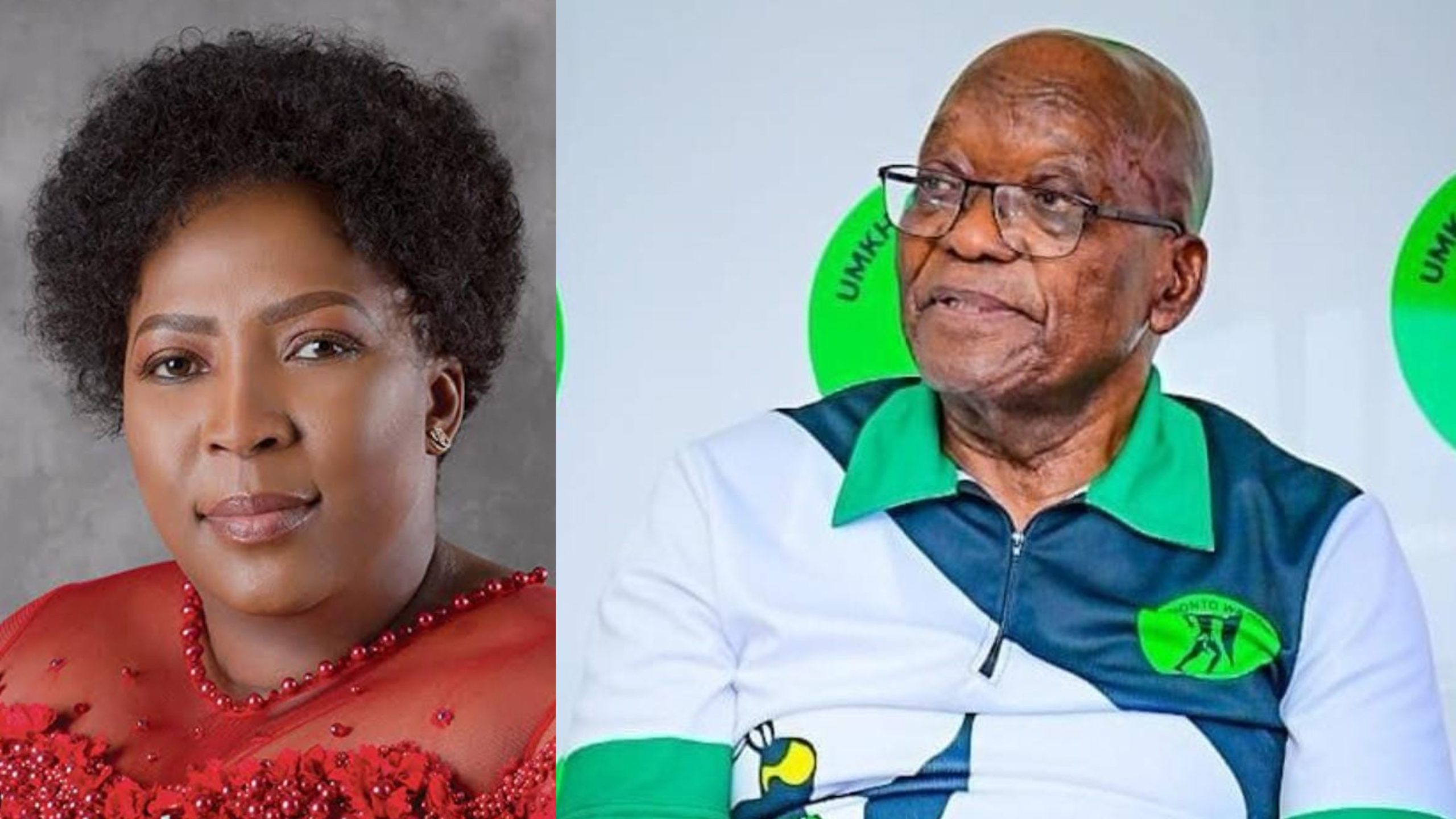
During the debate on the 2026 State of the Nation Address (SONA), tensions rose in Parliament when the Chairperson of the National Council of Provinces, Refilwe Mtshweni-Tsipane, originally refused to acknowledge the presence of former President Jacob Zuma, who was present at the sitting in Cape Town.
Almost immediately, the unexpected event triggered comments all over the chamber, with members expressing varying interpretations of the etiquette that is followed in the parliamentary process. During the brief transition from the scheduled debate to the procedural disagreement, observers saw that members of parliament appeared to be in a state of obvious perplexity.
The issue was brought up in a forceful manner by the EFF Member of Parliament, Leigh-Ann Mathys, who questioned the decision made by the chairperson and demanded that the House rules be adhered to. Mathys made his argument to the officer who was presiding over the meeting, arguing that parliamentary traditions allow for the recognition of former leaders of state regardless of their party affiliation.
This is what Mathys had to say to the house chair: “I believe you need to go back and read the rules correctly.” We acknowledged a previous state president here in this House, regardless of how you feel about Vice President Zuma, who served as President of South Africa. It is irrelevant whether you have a favourable opinion of former President Zuma or not. Once upon a time, he served as the president of the state.
The mood within the chamber became more intense as a result of her words, with some members of parliament clapping while others objecting. According to Mathys, the acknowledgement of former presidents should be based on the principle of institutional respect rather than on the politics of political parties.
In her response, Mtshweni-Tsipane stated that she had already given a verdict on the case, and she urged the members to proceed with the agenda that was scheduled. Nevertheless, Mathys continued to call into doubt the reasoning behind the decision.
It was her question, “Which rules did you read in order to say that?” “It is not possible to simply rule out of your head. This is not a gathering about a party. While we are in Parliament, there are rules that must be followed.
Particularly in light of Zuma’s leadership role in the MK Party, the exchange brought to light deeper concerns concerning the decorum of the parliament and political differences. The discussion came to a halt for a brief period of time as participants continued to raise concerns and submit points of order.
Almost immediately after that, Mtshweni-Tsipane went back to the subject and formally accepted Zuma’s presence.
“Before I call upon the next speaker, I would want to take this occasion to acknowledge the presence of Jacob Zuma, who served as President of the Republic of South Africa in the past. She stated that he was present with us at this time.
Mixed responses were received in response to the admission, which is reflective of the extremely volatile political context. Some members of parliament were pleased with the revision, while others saw the earlier argument as an indication of the increasing friction that exists inside the operations of the parliament.
The event soon gained steam on social media, as videos of the encounter were extensively shared and shared by a large number of people.


