

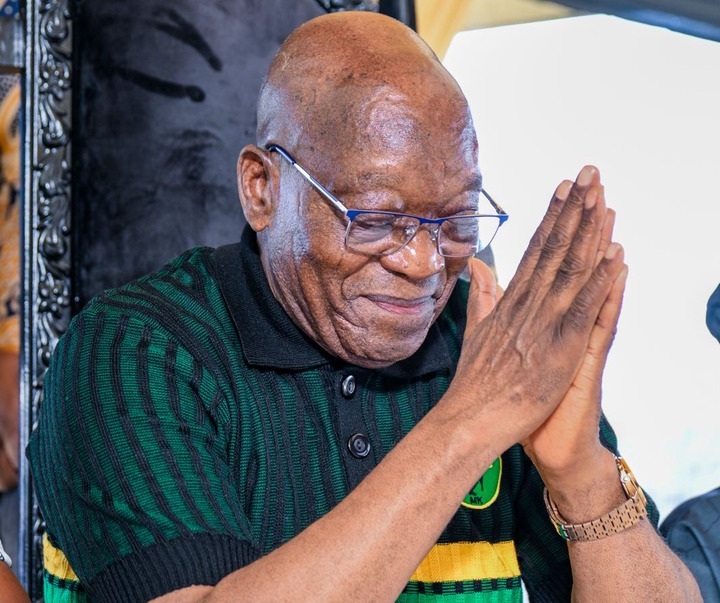
The African National Congress is bracing for a highly charged leadership contest at its 2027 National Conference, with the anticipated return of former president Jacob Zuma threatening to upend factional dynamics and reshape the party’s future .
Zuma, often referred to by his clan name uNxamalala, was expelled from the ANC in July 2024 after forming the uMkhonto weSizwe (MK) party while still claiming to be an ANC member . The party’s national disciplinary committee found him guilty of contravening the constitution by campaigning for and voting with the MK party.
Despite his expulsion, Zuma has repeatedly demanded reinstatement, giving the ANC an ultimatum in January 2025 and threatening legal action . Political analysts say the 2027 conference may be his last opportunity to reclaim formal membership and influence within the party.
“He will remain an albatross around the ANC’s neck,” political analyst Professor Sam Koma told YFM. “His expulsion was confirmed by the ANC’s national disciplinary committee, meaning all internal avenues have been exhausted. But Zuma is very familiar with the party’s processes and will always attempt to test the waters” .
High Stakes for ANC Leadership
The conference comes at a critical juncture for the ANC, which saw its electoral support plummet to 40.18% in the 2024 general election . President Cyril Ramaphosa will step down as party leader at the conference, though he will continue as head of state until the 2029 elections .
Deputy President Paul Mashatile is viewed as the frontrunner to succeed Ramaphosa, following the tradition of ANC deputies ascending to the presidency . However, his path is far from certain. Factional battles have intensified, with Gauteng Premier Panyaza Lesufi, Secretary-General Fikile Mbalula, and former health minister Zweli Mkhize also seen as potential contenders .
The delay in restructuring party leadership in key provinces like Gauteng and KwaZulu-Natal has been attributed directly to succession battles, with factions manoeuvring to block or advance certain candidates .
Zuma’s Strategic Positioning
Zuma’s MK party shocked the political landscape by becoming the official opposition after the 2024 elections, siphoning significant support from the ANC in KwaZulu-Natal and beyond . Analysts suggest Zuma’s push to return to the ANC fold may be aimed at reuniting the party with his breakaway movement.
Goodenough Mashego, an independent political analyst, believes Zuma is strategic with his timing. “I don’t think Zuma wants to return to the ANC, because the ANC that he left is no longer the ANC that he will return to. It’s really to say let’s change the conversation” .
The Zuma factor already contributed heavily to the ANC’s electoral decline in 2024, and his presence at the 2027 conference could either help rebuild bridges or deepen divisions .
Uncertain Succession and Coalition Future
The ANC’s leadership transition carries high stakes not only for the party but for the Government of National Unity. The DA has made clear it would only collaborate with the ANC if led by Ramaphosa . A new leader emerging from the 2027 conference could strain coalition dynamics.
Professor Bheki Mngomezulu from Nelson Mandela University warns that factionalism has “destroyed the ANC” and the 2027 conference will determine whether the party produces a leader based on merit or one imposed by a dominant faction .
“The party has its work cut out in trying to produce a leader who will unite the party and lead it to the 2029 general election,” he wrote. “Such a leader should be able to relate with other political parties since the chance of a single party meeting the fifty-plus-one threshold is very slim” .
The Brenthurst Foundation notes that Ramaphosa will be a “spent force with rapidly diminishing political power” after the conference, leaving the post-Ramaphosa future frighteningly uncertain .
With local government elections scheduled for November 2026 serving as a key test of party strength, the countdown to 2027 has already begun. Whether Zuma returns as a unifier or a disruptor will define not only the conference but the ANC’s trajectory for years to come.


