
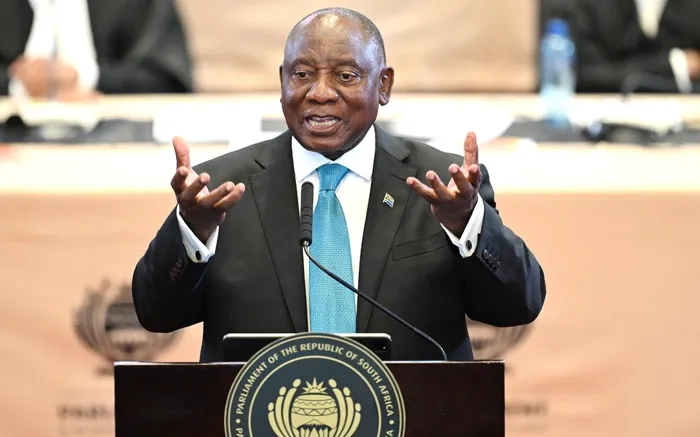
President Cyril Ramaphosa delivered a dual immigration message in his State of the Nation Address on Thursday, 12 February 2026, announcing intensified border security and labour enforcement while issuing a firm warning that foreign nationals must not be unlawfully denied access to public facilities .
Delivering his ninth SONA at Cape Town City Hall, Ramaphosa described illegal immigration as “a risk to our security, stability and economic progress” and outlined several new enforcement measures .
Border security and labour enforcement
The president announced that funding will be prioritised to strengthen border security, covering infrastructure, technology and personnel. Key border posts will be redeveloped through public-private partnerships, and the Electronic Travel Authorisation system will be extended to all international airports and the busiest land ports of entry .
Drones and surveillance technology are already being deployed more extensively along South Africa’s borderlines, Ramaphosa said . The Border Management Authority has established a dedicated drone operations response team and deployed armoured vehicles as deterrents to cross-border crime, particularly along the Limpopo River corridor .
Inside the country, police, Home Affairs officials and labour inspectors will collaborate to enforce immigration, labour and related laws. Ramaphosa issued a direct warning to employers: “Employers who hire foreign nationals without the required permits or visas will face the full force of the law” .
To tighten enforcement, government will hire an additional 10,000 labour inspectors this year . This follows a previously announced two-year recruitment plan that aims to add 20,000 inspectors by 2026 to tackle labour violations, including the employment of undocumented foreign nationals .
Constitutional boundaries on enforcement
However, Ramaphosa was equally emphatic that immigration enforcement must not descend into vigilantism or unlawful exclusion .
“No foreign national should be unlawfully barred from accessing public facilities, including schools and health facilities,” the president said .
He explicitly criticised groups such as Operation Dudula and the March and March movement, whose members have previously blocked undocumented migrants from accessing healthcare facilities and schools. “We will not tolerate violence and other acts of lawlessness directed at foreign nationals,” Ramaphosa said .
Context: Ongoing tensions over service access
The president’s remarks come amid heightened tensions across several provinces. In KwaZulu-Natal, local parents clashed with parents of undocumented children outside Addington Primary School in January over admissions, with community groups claiming South African children were being displaced . Provincial Education MEC Sipho Hlomuka stated at the time that the government was constitutionally bound to provide education to all children regardless of legal status .
Similar blockades have occurred at healthcare facilities. In 2025, vigilante groups placed themselves at the gates of clinics in Rosettenville and Yeoville, demanding identity documents and denying access to those who could not produce them . A landmark South Gauteng High Court judgment, penned by Judge Stuart Wilson, later reaffirmed that the constitutional right of access to healthcare includes the right to reach and use facilities without unlawful interference .
Legal position remains settled
Education and legal experts stress that the legal framework is unambiguous. Section 29(1)(a) of the Constitution guarantees every child in South Africa the right to a basic education, regardless of nationality or documentation status . Courts have repeatedly struck down policies requiring birth certificates or permits as conditions for admission .
Similarly, Section 27 of the Constitution guarantees everyone the right of access to healthcare services, and the state is constitutionally obliged to take reasonable measures to progressively realise that right . Parliamentary committees previously condemned threats by Operation Dudula to target schools and clinics, with Education portfolio committee chairperson Makhi Feni stating: “What is there to gain by refusing a poor Zimbabwean entry into a clinic?” .
A political balancing act
Ramaphosa’s SONA message reflects a deliberate balancing act. On one hand, government is responding to mounting public frustration over unemployment, porous borders and strained public services. On the other, it is attempting to prevent anti-immigrant activism from crossing into violence or unlawful exclusion .
“As we undertake these interventions, we insist that the laws of our country must be observed by everyone,” Ramaphosa said .
His address signals that while illegal immigration will be tackled decisively through stronger border management, technology, labour inspections and employer liability, enforcement remains the sole responsibility of the state. Communities, he made clear, cannot take the law into their own hands .


