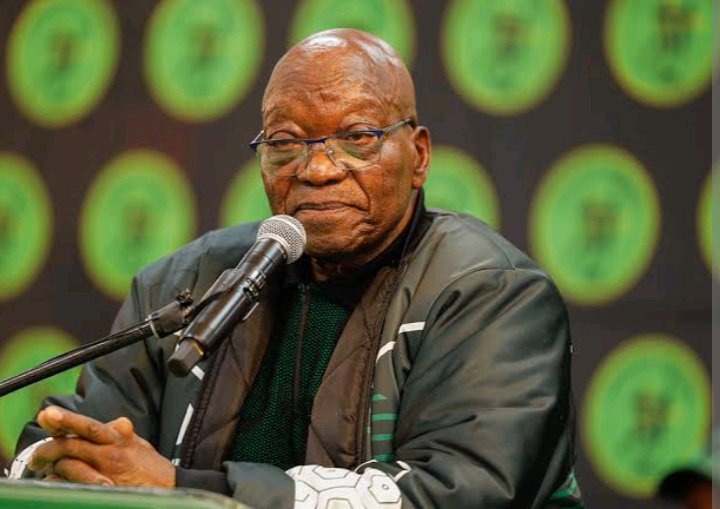
Jacob Zuma, a former president of South Africa and the leader of the uMkhonto weSizwe (MK) Party, has provided a rare personal reflection on the pressures he claims have followed the birth of the MK Party. He has revealed how the rapid rise of the MK Party has disrupted his private life and highlighted the reasons why he believes that strong leadership is now essential.
Zuma told his followers, “I have to tell you a story that you are not familiar with.” “Ever since uMkhonto weSizwe was brought into existence, I have been unable to sleep in my own home because everyone comes, and everyone comes from everywhere.”
The observation, which was delivered with the characteristic candour that is characteristic of the speaker, creates a picture of a movement that has grown faster than its structures, attracting followers, leaders, and inquisitive bystanders from cities all over the country. Zuma saw the steady flow of visitors as a representation of the MK Party’s popularity as well as the critical requirement for the establishment of organisational discipline.
The president of the MK Party has stated that the phase in question is nearing its conclusion.
A transition from informal mobilisation to coordinated governance inside the party was signalled by Zuma’s statement, which stated, “Now we are saying that thing is going to come to an end because the leadership here is the one that is going to lead with the leadership up there.”
The words made by Zuma are seen by political observers as an attempt to persuade both supporters and critics of the MK Party that the party is maturing. Concerns have been raised over the organization’s internal coherence, decision-making mechanisms, and long-term strategy, despite the fact that its quick emergence has already disrupted the political landscape of South Africa.
It is possible that there is a more distinct chain of command between the grassroots structures and the national leadership, as shown by Zuma’s focus on aligned leadership “here” and “up there.” By strengthening discipline, improving communication, and preparing the party for persistent political engagement rather than spontaneous activity, according to those with knowledge of the situation, this alignment is supposed to accomplish something.
Advocates expressed their satisfaction with the message, perceiving it as an indication that the MK Party is transitioning from a state of protest energy to an institutional preparation. After the address, a member of the party offered the following statement: “People are excited, but excitement needs direction.” “The president is referring to that concept,” the speaker said.
Critics, on the other hand, continue to exercise caution, stressing that strong leadership must be accompanied by transparent processes and clear policy. They make the observation that in a political environment that is highly competitive, popularity alone cannot serve as a substitute for organisational depth.
Despite this, Zuma’s story struck a chord with a significant number of the audience members. Through framing leadership as both a personal imperative and a political responsibility, he reinforced his primary message, which is that the next chapter of the MK Party would be defined not only by who shows up, but also by who leads and how they lead.