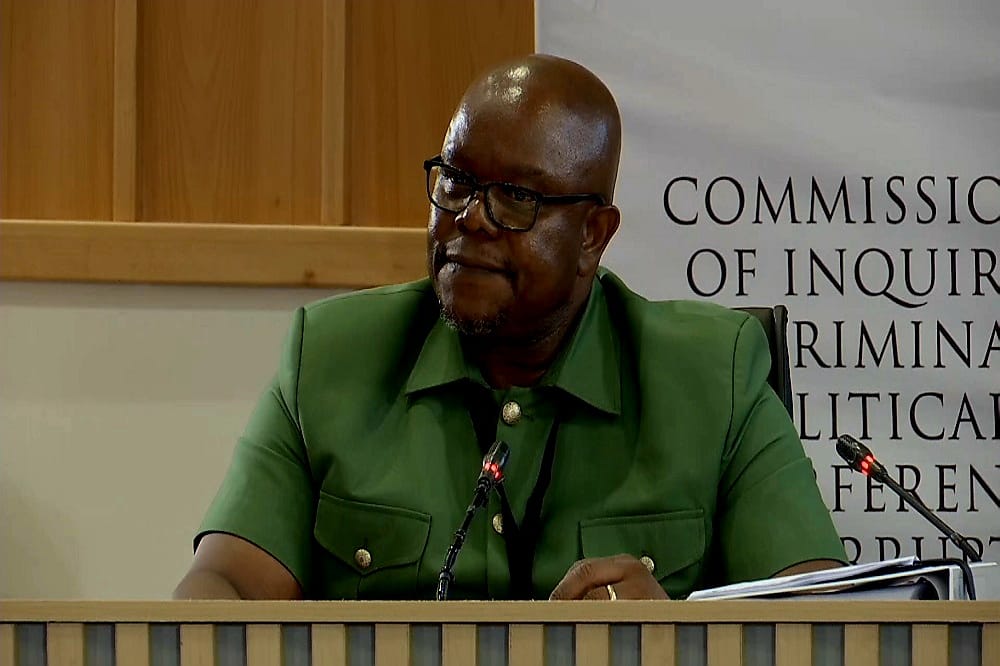
In yet another revealing moment at the Madlanga Commission, Major General Lesetja Senona found himself defending not just his actions but his demeanor, after Justice Madlanga observed that the Hawks head appeared dismissive and impatient during questioning by Advocate Hassim. Senona’s insistence that he was neither abrupt nor irritated rings hollow to anyone who has followed his testimony a masterclass in evasion, convenient amnesia, and increasingly strained explanations that has now apparently manifested in body language so problematic that the presiding justice felt compelled to address it directly.
Justice Madlanga’s intervention is significant precisely because judges typically maintain careful neutrality about witness demeanor, allowing testimony to speak for itself rather than editorializing about attitude or comportment. That he felt it necessary to comment on Senona’s dismissiveness suggests the behavior was sufficiently pronounced to potentially undermine the proceedings or demonstrate contempt for the investigative process. You don’t get called out by a sitting justice for appearing impatient unless your conduct has crossed lines that demand correction.
Senona’s denial “I was not abrupt or irritated” asks the commission to disbelieve their own observations in favor of his self-assessment. This is characteristic of his entire testimony strategy: deny what seems obvious, reframe what’s been admitted, and maintain a posture of injured innocence despite accumulating evidence of misconduct. But unlike claims about forgotten meetings or business relationships, demeanor is something everyone in the room witnesses directly. Justice Madlanga wasn’t speculating about private conduct—he was describing what he and everyone present could see.
The specific targeting of Advocate Hassim’s questioning is particularly telling. Hassim presumably represents the prosecutorial or investigative function at the commission, tasked with extracting truth through rigorous examination. If Senona appeared dismissive specifically during Hassim’s questioning, it suggests discomfort with a line of inquiry that was proving effective in exposing contradictions or eliciting damaging admissions. The irritation Justice Madlanga observed might have been Senona’s psychological response to feeling cornered by questions he couldn’t deflect through his usual repertoire of evasions.
This confrontation about demeanor follows a testimony that has systematically revealed a web of inappropriate relationships and conduct: exchanging numbers with “Cat” Matlala at his 2019 wedding, forwarding sensitive documents because of social media attention, advising Matlala’s security business and connecting him to experts, accompanying him to whiskey-fueled meetings with Lieutenant Generals, having a son who conducts business with the same figure, facilitating requests for the police minister’s contact information, and denying financial interests while benefits flowed to family members.
Against this backdrop of devastating revelations, Senona’s irritation during aggressive questioning seems entirely predictable. He walked into this commission apparently expecting to control the narrative, limit his exposure to a single day, and manage the damage through strategic admissions and denials. Instead, Justice Madlanga extended his testimony indefinitely, and Advocate Hassim has systematically extracted admission after damaging admission, painting a comprehensive picture of corruption and abuse of office that grows more damning with each session.
The psychological pressure of this extended testimony would test anyone’s composure. But Senona isn’t just anyone he’s a Major General, someone who theoretically possesses the discipline and professional bearing to maintain composure under pressure. That he’s apparently displaying visible irritation and dismissiveness suggests either the questioning has proven particularly effective in undermining his defenses, or his temperament under scrutiny reveals someone less suited to senior leadership than his rank suggests.
Justice Madlanga’s willingness to call out this behavior also signals that the commission won’t tolerate witnesses treating the proceedings with contempt or attempting to rush through uncomfortable questioning through displays of impatience. By directly addressing Senona’s demeanor, Madlanga reinforces that witnesses don’t control the pace, tone, or duration of examination—the commission does, and visible irritation at thorough questioning will be noted and corrected rather than accommodated.