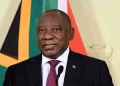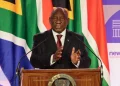

Former South African Minister of International Relations and Cooperation, Dr Naledi Pandor, has revealed that President Cyril Ramaphosa once asked her to serve as his deputy, an offer she ultimately declined due to concerns about the political environment surrounding him.
Speaking candidly in a recent reflection on her time in government, Pandor said she was not impressed by what she described as “the clowns surrounding him and their shenanigans,” a factor she cited as central to her decision to turn down the position. Her remarks have reignited debate about internal dynamics within the African National Congress (ANC) and the challenges facing governance at the highest level of the state.
Pandor, a respected academic and seasoned politician, has long been regarded as one of the ANC’s most principled and capable leaders. Over the years, she has served in several senior portfolios, including Education, Science and Technology, Higher Education, and International Relations, earning a reputation for discipline, policy depth, and integrity.
According to Pandor, while the invitation from Ramaphosa was significant, she felt that accepting the role would have required her to operate within a political space dominated by factionalism and unproductive conduct. She suggested that these surrounding influences undermined effective leadership and distracted from the serious work of governing the country.
Her comments come at a time when public confidence in political leadership remains fragile, with ongoing concerns about corruption, internal party infighting, and the erosion of institutional credibility. Analysts say Pandor’s decision highlights a broader struggle within the ANC, where capable leaders often find themselves constrained by internal power battles and competing interests.
Political observers note that Pandor’s refusal also underscores her independence and unwillingness to compromise her principles for political advancement. Unlike many within the party, she has consistently avoided populist rhetoric, opting instead for a measured and policy-driven approach to leadership.
While President Ramaphosa has not publicly responded to Pandor’s remarks, the revelation adds another layer to discussions about his leadership style and the team he has assembled around him. For many South Africans, Pandor’s statement serves as both a critique of the current political culture and a reminder of the standards of leadership the country continues to seek.