

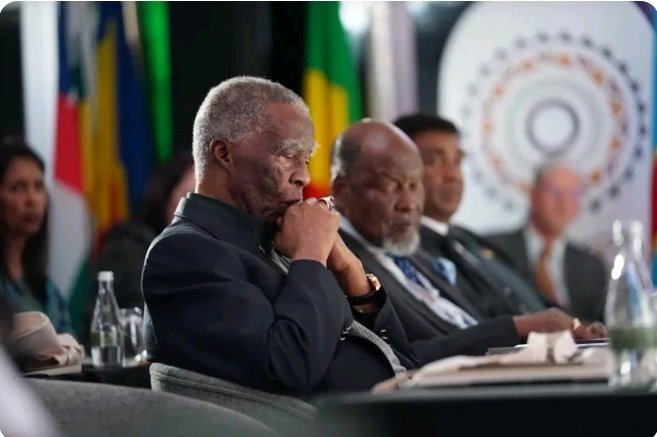
Former President Thabo Mbeki has issued a grave warning that the African National Congress (ANC) is in significant jeopardy, asserting that South Africa is increasingly descending into crisis due to the ruling party’s detachment from the realities experienced by ordinary citizens. Speaking frankly, Mbeki depicted a concerning scenario of a nation struggling with economic downturn, high unemployment rates, deteriorating public services, and an increasing sense of hopelessness among its citizens.
Thabo Mbeki stated that the greatest threat facing the ANC is its failure to candidly acknowledge its own shortcomings. According to him, South Africa’s challenges are no longer theoretical policy discussions but the daily hardships faced by millions dealing with poverty, crime, power outages, and deteriorating infrastructure. He cautioned that unless the ANC promptly reevaluates its governance strategy, it jeopardises its longstanding position as a trusted societal leader.
Mbeki highlighted that the intensification of the crisis did not occur suddenly. He attributed it to years of ineffective leadership, inadequate accountability, and internal divisions within the ANC that have diverted the party’s focus from serving the public. He contended that corruption and state capture undermined public trust and debilitated essential institutions, rendering the nation susceptible and unstable. In his perspective, the inability to effectively address these issues has permitted discontent to accumulate among the electorate.
The former president also expressed concern regarding the increasing disparity between political leaders and local communities. He stated that numerous citizens no longer feel their voices are being heard, which has contributed to increased resentment, protests, and a decline in voter participation. Thabo Mbeki cautioned that neglecting this disconnect could lead to significant repercussions for both the ANC and the nation’s democratic trajectory.
Central to Mbeki’s message was an appeal for self-reflection. He called upon the ANC to relinquish complacency and cease presuming voter loyalty solely on historical allegiance. He emphasised that credentials related to liberation cannot replace effective governance, ethical leadership, and demonstrable improvements in the lives of individuals.
Mbeki’s warning arrives at a pivotal juncture, as South Africa encounters increasing economic challenges and political instability in the lead-up to upcoming elections. His remarks function as a stark reminder that the ANC’s continued existence and the nation’s stability rely on decisive reforms and a renewed dedication to public service rather than internal power conflicts.


