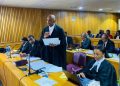

Political disagreements within South Africa’s government have escalated following a significant legal and political defeat for the MK Party. The party had attempted to challenge the suspension of Police Minister Senzo Mchunu and to prevent President Cyril Ramaphosa from proceeding with the Madlanga Commission of inquiry. This court ruling represents a new development in the growing conflict between the MK Party and the national executive, as both sides continue to engage in disputes over responsibility, authority, and differing political interpretations.
The MK Party had gone to court seeking immediate intervention. They argued that the suspension of Minister Mchunu was illegitimate, unreasonable, and driven by political motives. The party maintained that the president had exceeded his constitutional authority by suspending the minister at a time when the country faced critical security issues that demanded consistent leadership. According to the MK Party, this action raised concerns that political interests were being prioritized over national security needs.
However, the court dismissed the application. It ruled that the president had acted within his constitutional rights and had followed the correct legal procedures. The judgment underscored that the president possesses the authority to suspend a cabinet minister when circumstances warrant it, particularly in situations where accountability or ongoing investigations might impact how the executive branch functions. The decision reinforced the idea that the head of the executive must be able to act decisively to maintain public confidence, even if those decisions are not politically popular.
In addition to contesting the minister’s suspension, the MK Party had also sought to stop the Madlanga Commission. President Ramaphosa established this commission to investigate alleged wrongdoing, failures in governance, and irregularities within certain security agencies. The MK Party claimed that the commission’s establishment was biased and intended to target political adversaries. They further alleged that the inquiry was strategically timed to weaken specific political groups in the lead-up to upcoming elections.
The court also rejected this argument, confirming that the commission was both legal and necessary. It determined that the president, in accordance with constitutional and legal provisions, has the authority to establish commissions of inquiry when matters of public concern require independent examination. The Madlanga Commission, led by the respected Justice Mbuyiseli Madlanga, was recognized as a legitimate body for uncovering facts that could strengthen governance and contribute to institutional improvements.
The MK Party’s loss in court has elicited varied responses across the political spectrum. Those who support the government view the ruling as a victory for accountability and the rule of law, asserting that independent investigations should be allowed to proceed without political interference. Conversely, critics who align with the MK Party see the outcome as further evidence of what they perceive as an abuse of executive power.
As the Madlanga Commission prepares to resume its work, the political atmosphere remains tense. The court’s decision is expected to influence future political discussions, particularly those concerning transparency, security management, and the division of powers. While the MK Party has indicated the possibility of further legal challenges, this ruling represents a significant endorsement of constitutional processes in South Africa’s developing democratic landscape.



![[Watch] Julius Malema under attack by AWB infront of Winnie Mandela House](https://ireportsouthafrica.co.za/wp-content/uploads/2023/08/x95iapbjszyigbcgzznx-120x86.jpeg)