
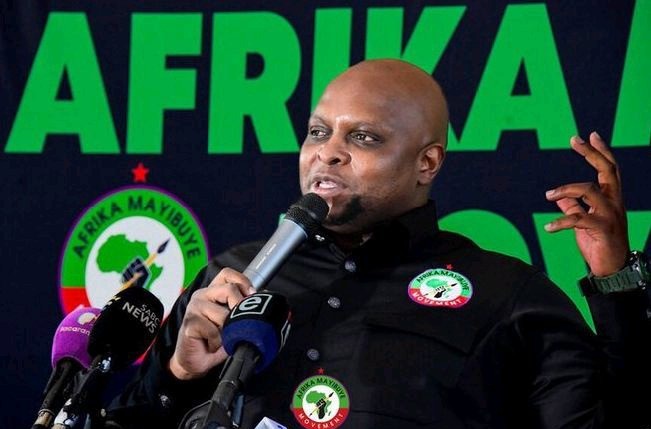
Floyd Shivambu’s Afrika Mayibuye Movement has called for the immediate disbandment of the Ad Hoc Committee established by Parliament to investigate the explosive allegations made by KwaZulu-Natal Provincial Police Commissioner, Lieutenant-General Nhlanhla Mkhwanazi. According to the movement, the parliamentary committee has no legitimacy to handle the matter because the politicians who form part of it are the same people accused of interfering in police work.
The movement argues that only the Madlanga Commission of Inquiry, established by the President, should be responsible for investigating the full scope of allegations involving corruption, political interference, and the infiltration of criminal syndicates within the South African Police Service. They say the Commission is a judicial structure, which is more independent and better positioned to probe sensitive and high-level allegations without political influence.
Floyd Shivambu’s Afrika Mayibuye Movement has called for the dissolution of the Ad Hoc Committee investigating General Nhlanhla Mkhwanazi’s allegations of corruption, criminal syndicate infiltration, and political interference in the police. pic.twitter.com/mlzXPnehPh
— MDN NEWS (@MDNnewss) December 7, 2025
Their stance is based on Mkhwanazi’s own claims that politicians have been interfering with police investigations for years, particularly those linked to political killings, organised crime, and high-profile corruption cases. Afrika Mayibuye says it is therefore illogical and dangerous for those same politicians to now oversee an investigation into accusations that directly implicate them. For the movement, this creates an obvious conflict of interest and undermines public trust in the process.
Meanwhile, the Madlanga Commission has continued to gather evidence and hear testimony from senior law-enforcement officials. Mkhwanazi previously warned the Commission that if corruption and interference are not addressed, the entire criminal-justice system faces the risk of collapse. His testimony placed particular focus on the disbanding of crucial investigative units and alleged collusion between senior police officials, politicians, and criminal syndicates.
Afrika Mayibuye believes Parliament’s involvement could be used to water down the allegations or influence public perception before the Commission completes its work. The movement insists that a judicial inquiry is the only credible platform capable of handling claims of this magnitude without fear or favour. They maintain that dissolving the Ad Hoc Committee would prevent duplication, protect the integrity of the investigation, and ensure that those implicated cannot interfere with proceedings.
As public pressure mounts, Parliament will now face questions about whether continuing with the Ad Hoc Committee adds clarity or confusion to an already sensitive national issue. For many South Africans, the core concern remains the same: whether the truth about corruption, political interference, and organised-crime influence within SAPS will finally come to light.