

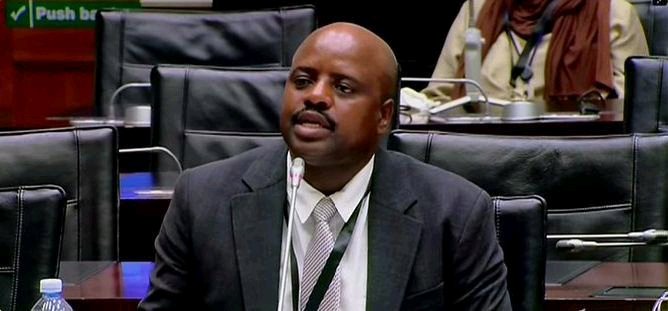
Before a parliamentary committee, Julius Mkhwanazi, the suspended deputy chief of the Ekurhuleni Metropolitan Police Department (EMPD), presented bombshell accusations. He said that a person known as “Witness D” had carried out killings at the behest of a province premier.
During a heated committee meeting, Mkhwanazi made the assertions while investigating claims of wrongdoing, political meddling, and criminal ties to law enforcement. All members of parliament, regardless of party, reacted strongly as his testimony raised the stakes of the proceedings.
It is claimed by Mkhwanazi that Witness D is a well-known agent who has participated in several assassinations carried out under political directives. He insisted that the top brass of the province had approved these crimes, rather than being random occurrences. Mkhwanazi maintained that pertinent authorities had previously been given thorough information, but he refrained from naming the premier in an open session.
Telling the committee, “I am not making reckless statements,” was Mkhwanazi’s words. “There is proof, and that proof is real.” In addition, he asserted that investigators may have access to supporting paperwork, testimony, and intelligence reports by following the proper legal procedures.
Several members of parliament demanded to know whether the committee had formally referred the issue to the National Prosecuting Authority or the Hawks after the claims sent shockwaves through the committee. Some voiced concern that the public’s faith in democratic institutions could be eroded by such grave accusations that lack evidence.
Mkhwanazi insisted that he had gone via the proper means to voice his concerns before, but that he had been ignored or marginalised because of it. His refusal to stay silent about alleged criminal activity involving politically connected individuals, he felt, was linked to his suspension.
The allegations, according to committee members, pose a serious danger to constitutional government and a flagrant violation of the rule of law if they were to be substantiated. The committee chair suggested that the matter might be sent to appropriate oversight and investigative agencies for additional review.
The testimony, according to political observers, might be a watershed moment in the investigation, leading to a broadening of the probe’s focus from administrative misbehaviour to charges of politically motivated violence.
Authorities are under increasing pressure to evaluate the allegations and decide quickly if a thorough criminal probe is necessary as the hearing progresses. Although the committee will not preside over a trial, it has made it plain that it demands honesty, openness, and promptness in the face of serious accusations.


