

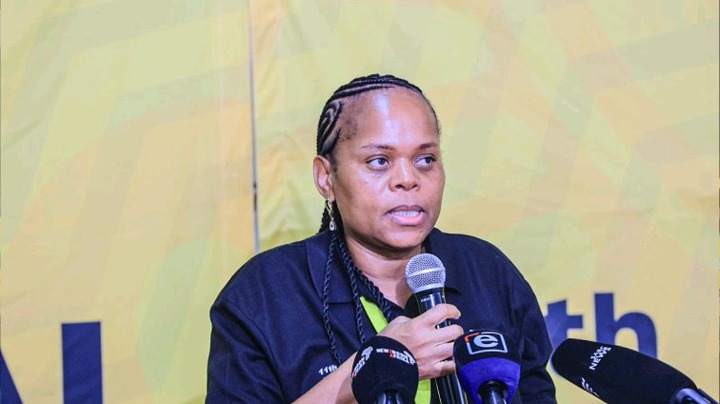
The ink was barely dry on her election as Limpopo’s first female ANC provincial chairperson when Dr Phophi Ramathuba stepped up to the podium and said the quiet part out loud. The newly elected Limpopo ANC chairperson acknowledged that the relationship between the ANC and SACP is strained, speaking at a media briefing during the 11th elective conference in Polokwane. This was not a slip of the tongue — it was a statement of historical fact dressed up as a diplomatic admission. Ramathuba has just been elected as the first female chairperson of the ANC in Limpopo, the only ANC province that received more than 70% support at the 2024 national and provincial elections — meaning her words carry the full weight of someone who leads the party’s single most loyal territory. When the strongest provincial chair in the ANC tells you the alliance is broken, it is broken.
The scenes at the Limpopo conference told the story before Ramathuba even spoke a word. When the SACP’s Percy Ndlala took the podium to deliver a message of support, delegates began booing loudly, howling and singing — arguing that the SACP should not be part of their conference as it was now directly contesting against the ANC, effectively making it an opposition party. Luthuli House had to intervene through its second deputy secretary-general Maropene Ramokgopa, who told the delegates she understood their “pain” and that the national leadership knew what they were feeling — but insisted the ANC was a rules-based organisation. Rules-based. This from the party currently drowning in Eastern Cape conference chaos, uninvestigated political killings files, and a suspended police minister its own NEC refuses to fire. The ANC invokes rules when rules are convenient, and ignores them when they are not.
The personal complexity of Ramathuba’s position adds another painful dimension to this unravelling. Ramathuba is deployed to her post as Limpopo Premier by the ANC and is a member of the ANC provincial executive committee — but was also the deputy chair of the SACP in the province. ANC secretary-general Mbalula cited Ramathuba as an example of a leader who had opted to align with the ANC, as the SACP’s decision to contest elections independently forced every dual-member to choose a side. SACP-affiliated ministers and deputy ministers, including higher education minister Buti Manamela, deputy finance minister David Masondo, and SACP chair Blade Nzimande, are all in their posts on ANC tickets — meaning the divorce, if it proceeds, will strip the SACP of its access to state power and strip the ANC of the ideological scaffolding it has leaned on for a century. This is not a spat. It is a structural collapse.
What Ramathuba’s plain-spoken admission reveals is that no amount of unity slates, keynote addresses, or carefully managed conference optics can paper over a fundamental rupture. Ramathuba questioned why the SACP was choosing to contest elections in Limpopo specifically, saying the ANC expects its national leadership to briefly resolve this matter — and confirming that yes, the relationship has been constrained, based precisely on that decision. The SACP’s decision marks another potential risk to the ANC’s electoral support at a time when it is scrambling to recover from its loss of an outright majority for the first time in three decades in the 2024 national election, with the SACP reportedly holding talks with Julius Malema’s EFF to unite leftist forces. The tripartite alliance — forged in the furnace of the liberation struggle, sustained through 30 years of democratic governance — is not fraying at the edges. It is collapsing from its centre. And Ramathuba, to her credit, was honest enough to say so.


