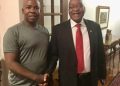

Calls are growing within Economic Freedom Fighters (EFF) circles for Dr Mbuyiseni Ndlozi to return to frontline party politics, with some members publicly suggesting that he should become the party’s mayoral candidate for Johannesburg. The renewed push follows online discussions and commentary sparked by a circulating social media post.
Supporters argue that Ndlozi, widely recognized for his articulate communication style and strong public presence, would present a formidable challenge to Herman Mashaba, whose political career continues to shape Johannesburg’s electoral landscape. While no official announcement has been made by the party, the debate has reignited conversations about leadership, strategy, and voter appeal ahead of future municipal contests.
Ndlozi remains one of the EFF’s most prominent figures despite stepping back from certain visible roles in recent years. Known for his background in political communication and his influential voice during parliamentary debates, he developed a strong following among younger voters and party loyalists alike. For many EFF members, his potential return represents not merely a symbolic gesture, but a strategic recalibration.
Johannesburg, South Africa’s economic hub, has long been a fiercely contested political battleground. Control of the metro carries significant political weight, often reflecting broader national trends. Analysts note that mayoral races in the city frequently become referendums on governance, service delivery, and coalition stability.
Mashaba, who previously served as Johannesburg’s mayor, remains a polarizing yet influential political figure. His reputation for business-oriented governance and anti-corruption rhetoric continues to resonate with segments of the electorate. As such, any candidate positioned against him would likely require strong public credibility and persuasive messaging.
Within this context, some EFF supporters view Ndlozi as uniquely equipped to engage urban voters. His ability to translate complex policy issues into accessible language is often cited as a key advantage. Online reactions suggest that many believe he could energize the party’s base while appealing to undecided voters.
However, political observers caution that internal party dynamics, coalition arithmetic, and broader voter sentiment ultimately determine electoral outcomes. Leadership decisions within the EFF typically emerge through structured party processes rather than public speculation.
Neither Ndlozi nor the EFF’s national leadership has formally responded to the circulating calls. Still, the discussion highlights ongoing debates about political renewal and candidate selection strategies.
As municipal politics continue to evolve, Johannesburg remains central to South Africa’s political narrative. Whether these grassroots calls translate into concrete political developments remains to be seen.