

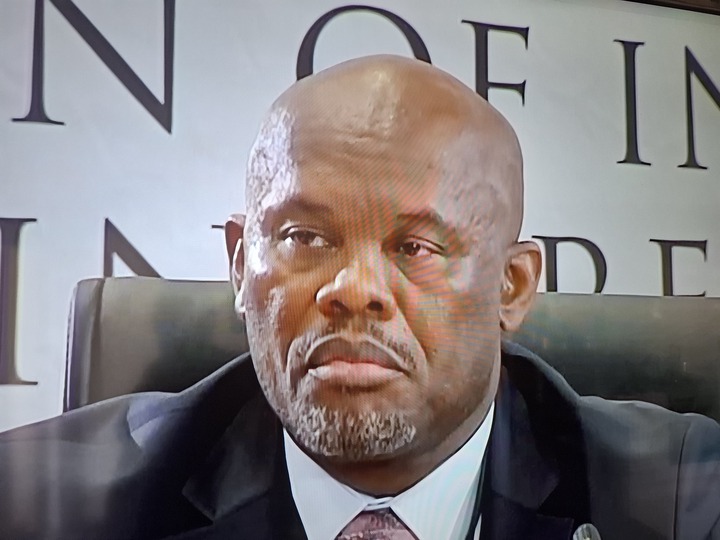
Tensions rose at the Madlanga Commission of Inquiry when Commissioner Justice Mbuyiseli Madlanga directly challenged General Shadrack Sibiya to point out where, in his submitted documentation, it explicitly states that a formal decision was taken to disband the Political Killings Task Team (PKTT).
The exchange marked a pivotal moment in the ongoing hearings, which are probing allegations of interference, administrative irregularities, and possible political influence within specialised investigative units. Justice Madlanga’s pointed question underscored the commission’s focus on documentary evidence and procedural accountability.
“Please indicate in your document where it states that a decision was taken to disband the PKTT,” Madlanga requested, emphasizing the need for clarity and precision in the official record.
The PKTT, established to investigate politically motivated killings particularly in KwaZulu-Natal has been central to the commission’s work. Its operational status and any alleged moves to dissolve or restructure it have raised concerns about the continuity and integrity of sensitive investigations.
Commissioner Madlanga asks General Shadrack Sibiya to indicate in his document where it states that a decision was taken to disband the PKTT.#MadlangaCommission pic.twitter.com/nWngJf4Kly
— MDN NEWS (@MDNnewss) February 19, 2026
General Sibiya, in response, attempted to clarify the context of his documentation, suggesting that discussions around restructuring or reconfiguration may have been misinterpreted as a decision to disband the unit entirely. However, commissioners pressed for concrete textual evidence rather than inferred intentions or verbal understandings.
Legal analysts observing the proceedings noted that the line of questioning signals the commission’s determination to distinguish between formal resolutions and informal discussions. The existence—or absence—of a written directive could prove critical in determining whether due process was followed and whether any attempt was made to undermine ongoing investigations.
The inquiry has repeatedly highlighted the importance of transparent governance within law enforcement structures, particularly in cases involving politically sensitive matters. Any ambiguity surrounding the PKTT’s status could have far-reaching implications for both past cases and public confidence in investigative institutions.
As proceedings continue, further testimony and documentary submissions are expected to clarify whether a formal resolution was ever adopted regarding the task team’s fate. For now, Madlanga’s insistence on documentary precision reinforces the commission’s broader mandate: to separate fact from assertion and to establish a verifiable account of decisions that may have influenced high-profile criminal investigations.
The spotlight remains firmly on institutional accountability as the commission works to untangle complex administrative and political threads surrounding specialised policing units in South Africa.


