

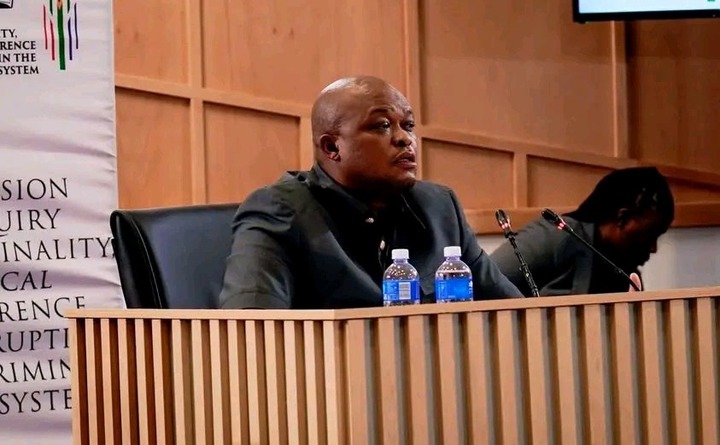
Brown Mogotsi, a controversial businessman from the North West, has reaffirmed his explosive claim that senior police officer Nhlanhla Mkhwanazi is connected to the Central Intelligence Agency (CIA). He has stated that he plans to submit additional proof when he appears before the Madlanga Commission again the following week.
The allegations made by Mogotsi, which were initially brought up during a recent hearing, have garnered significant attention from the general public and prompted controversy in political and security circles. During his remarks to the media following the proceedings, he emphasised that his sentiments were not made in a flippant manner and that he remains steadfast in his commitment to the commission’s findings. “I am prepared to substantiate my claims,” he stated, adding that additional material would be presented through the appropriate legal procedures following the aforementioned statement.
In response to the most recent remarks, General Mkhwanazi has not provided a public response that is detailed. On the other hand, officials who are close to the situation have suggested that any charges that touch on national security or international intelligence links are taken seriously and evaluated in light of facts that can be verified. Those who are knowledgeable in the law point out that commissions of inquiry are dependent on documentary evidence and sworn testimony, and that allegations that have not been tested are not considered findings.
Following its establishment with the purpose of investigating sensitive governance and security-related matters, the commission has reaffirmed its dedication to the principle of due process. The mandate of the investigation, according to sources within the investigation, involves determining the reliability of all of the testimony and making certain that individuals listed in the proceedings are given an equal opportunity to speak their minds.
Allegations that include foreign intelligence services have the potential to increase public fear and should be handled with prudence, according to analysts concerned with the matter. “Extraordinary claims require credible evidence,” stated a governance specialist, highlighting the significance of maintaining the integrity of institutions and the presumption of innocence.
The continuity of operations and the trust of the public continue to be the primary concerns among the policing community. The South African Police Service has not yet issued a formal statement regarding the claims in question; nevertheless, in the past, it has emphasised the importance of its internal oversight processes and its willingness to cooperate with authorised investigations.
Whether or not Mogotsi is able to present evidence that can be independently verified to back up his claims is likely to become the primary focus of attention as the next session draws near. For the time being, the work of the commission is still being scrutinised by the public, and watchers are anticipating getting clarification as the evidence is examined and replies are recorded. During this interim period, officials are urging caution and highlighting the fact that the outcomes of the investigation will be based on facts submitted under oath rather than speculation.


