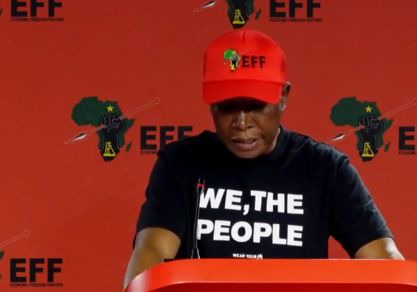
Economic Freedom Fighters (EFF) leader Julius Malema has suggested that divisions within the African National Congress (ANC) could lead to the formation of a new political party if certain factions fail to secure victory at the party’s 2027 elective conference.
Speaking during a recent address, Malema argued that internal tensions within the ANC have intensified over the years, warning that the outcome of the 2027 conference could trigger significant political realignments within South Africa’s governing party. According to Malema, history has shown that leadership contests within the ANC often result in breakaway movements when factions lose influence.
Malema said the ANC is increasingly characterised by internal competition, with various groups positioning themselves ahead of the crucial conference where new leadership will be elected. He maintained that if some factions fail to achieve their desired outcomes, they may resort to forming a new political organisation to maintain their relevance in the country’s political landscape.
The EFF leader referenced previous instances where internal ANC disputes led to the establishment of new political parties. Over the past two decades, South Africa has witnessed several breakaway groups formed by former ANC members who were dissatisfied with leadership outcomes or policy directions.
Malema further claimed that factional battles within the ruling party have weakened its unity and distracted it from addressing pressing national issues such as unemployment, poverty, and service delivery. He argued that ongoing internal conflicts have reduced the ANC’s effectiveness in governance and have contributed to declining public confidence in the party.
Despite his criticism, Malema acknowledged the ANC’s historical role in South Africa’s liberation struggle but maintained that the organisation is currently facing serious internal challenges that could reshape the country’s political future. He said voters are increasingly looking for alternative political movements capable of addressing socio-economic challenges.
Political analysts have previously noted that leadership contests within major political parties often influence broader national politics, particularly in South Africa where the ANC remains a dominant political force. Should a new party emerge following the 2027 conference, it could potentially alter the balance of power and coalition dynamics ahead of future national elections.
The ANC has not officially responded to Malema’s remarks. However, party leaders have consistently maintained that internal democratic processes remain a strength rather than a weakness, emphasising that leadership contests are part of the organisation’s constitutional framework.
As political parties begin positioning themselves for the coming years, attention is likely to intensify around the ANC’s internal dynamics and their potential impact on South Africa’s political landscape leading up to and beyond the 2027 conference.