

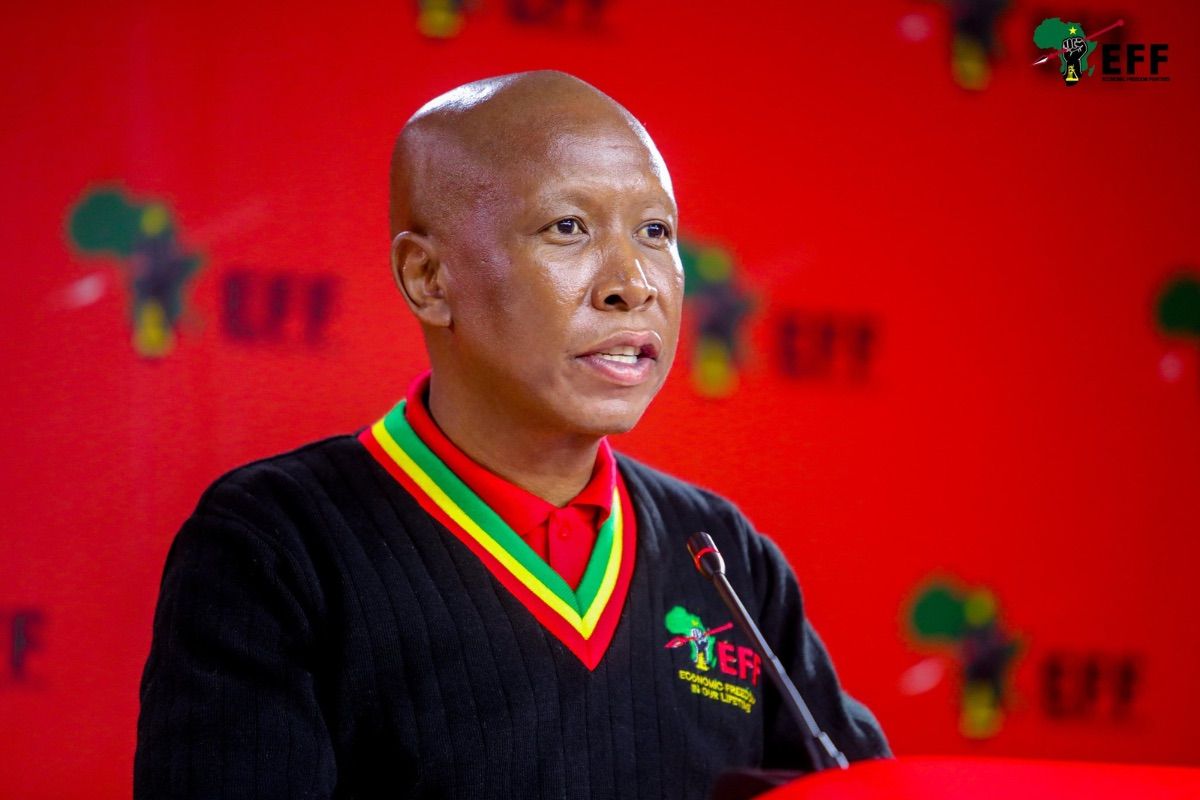
Economic Freedom Fighters (EFF) leader Julius Malema delivered a passionate and resolute statement during a media briefing on Wednesday, emphasising that he remains undeterred by speculations suggesting that the United States may impose restrictions on his entry. In the traditional style of Malema, the CIC utilised the platform not only to defend his stance but also to reaffirm his political foundation on the African continent.
“Even if the United States determines that I should no longer be permitted entry, that is acceptable,” Malema stated amid enthusiastic acclaim. I will enter Zimbabwe, I will enter Botswana, I will enter Nigeria, I will enter Africa—my homeland.
The remarks were made amidst persistent speculation that the United States may impose stricter visa restrictions on specific international political figures. Malema, however, disregarded the speculation with incisive wit and a sense of pan-African pride. He underscored that no Western nation possesses the authority over his identity, significance, or political objectives.
He proceeded to question what he referred to as the “obsession with Western approval,” asserting that African leaders and citizens must cease to regard entry into the United States as an indicator of success or legitimacy.
Why should I be concerned about individuals who will serve me patties and contribute to my gaining weight? Malema remarked humorously, eliciting mirth throughout the room. The remark, though humorous, conveyed a sharp message regarding opposition to Western cultural hegemony and economic reliance.
Malema’s remarks engage with enduring discussions regarding Africa’s geopolitical independence, Western intervention, and the continent’s persistent effort to establish its own trajectory. By referencing Zimbabwe, Botswana, Nigeria, and the broader African continent, he established himself as a pan-African figure rather than solely a South African political representative.
Political analysts observe that Malema frequently employs pan-African rhetoric to reinforce his ideological identity and resonate with younger, nationalist-oriented audiences disillusioned by global disparities. Wednesday’s press conference reaffirmed this strategy, depicting the EFF leader as resolute, confident, and anti-imperialist.
He additionally criticised African elites who, in his words, “act as if they require Europe or America to survive,” calling for a transition towards greater mutual respect, trade, and solidarity within Africa. Malema emphasised that Africa’s progress depends not on external approval but on unity and self-determination.
As South Africa approaches a tense political period, Malema’s remarks are anticipated to amplify both backing and examination. Although his critics accuse him of performative theatrics, his supporters perceive his stance as invigorating, courageous, and genuinely representative of African identity.
For Malema, however, the message was straightforward: his identity and political purpose are confined to African soil. Whether Washington’s approval is granted or not seems to be of minimal concern to him.
In his own words: “America can close its doors. Africa will always open hers.”


