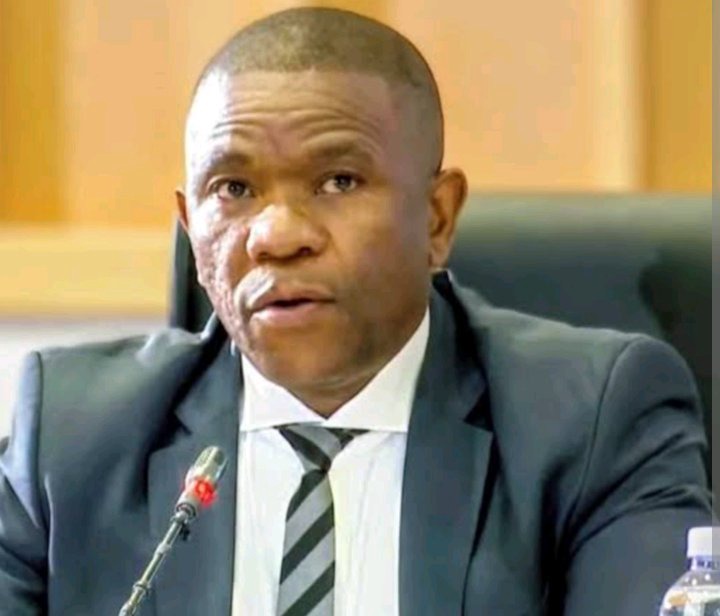
There was a heated discussion that took place in front of the Ad Hoc Committee, during which Fadiel Adams severely criticised Nhlanhla Mkhwanazi, the Commissioner of the KwaZulu-Natal Police Department. Adams referred to Mkhwanazi as a “constitutional delinquent” and accused him of seeking to coerce a whistleblower.
Adams stated to the committee that the conduct of the General were not only improper but also in violation of the ideals that are outlined in the Constitution. During his testimony, Adams stated, “The man wants me to imprison myself for reporting a crime against him.” If I were to cover up a crime, he would prefer it.
Adams and the senior police officer are engaged in a conflict that is intensifying, which is centred on charges that Adams legitimately reported criminal behaviour but is now facing retribution for doing so. The remarks indicate that the dispute is growing. Any assertion that he engaged in illegal behaviour is, in Adams’s opinion, completely without foundation.
“I am covered by court, two rulings, and the Cabinet document,” he asserted, highlighting the fact that his viewpoint is supported by both legal and executive frameworks. He went on to deny any criticism that could have been directed on him by the police commissioner, saying, “I’m not here for his opinion… The opinion that he has is irrelevant to me.
The debate was characterised as a more comprehensive problem of accountability and constitutional obligation that Adams presented in his testimony. Adams gave the impression that the commissioner’s actions undercut the very judicial system that he has taken an oath to preserve when he referred to General Mkhwanazi as a “constitutional delinquent.”
The Ad Hoc Committee has been tasked with reviewing the situation, and it is expected that its members would evaluate not only the legal protections that Adams mentioned, but also the larger ramifications for governance and the control of law enforcement. The claims raise significant questions regarding transparency, protections for whistleblowers, and the integrity of the institution, despite the fact that General Mkhwanazi has not yet provided a public response to Adams’ most recent remarks before the committee.
Legal experts point out that if Adams’ assertion that he is shielded by a number of court decisions is shown to be true, it might bolster his position that any attempt to prosecute or jail him would be invalid from a legal standpoint. Nevertheless, the findings of the committee will most likely have an effect on how the general public perceives whether or not this disagreement is the result of a failure in communication, a conflict of authority, or more fundamental structural problems.
As the processes continue, the question of whether constitutional safeguards are being preserved or contested inside South Africa’s law enforcement leadership structures continues to be the focus of attention.